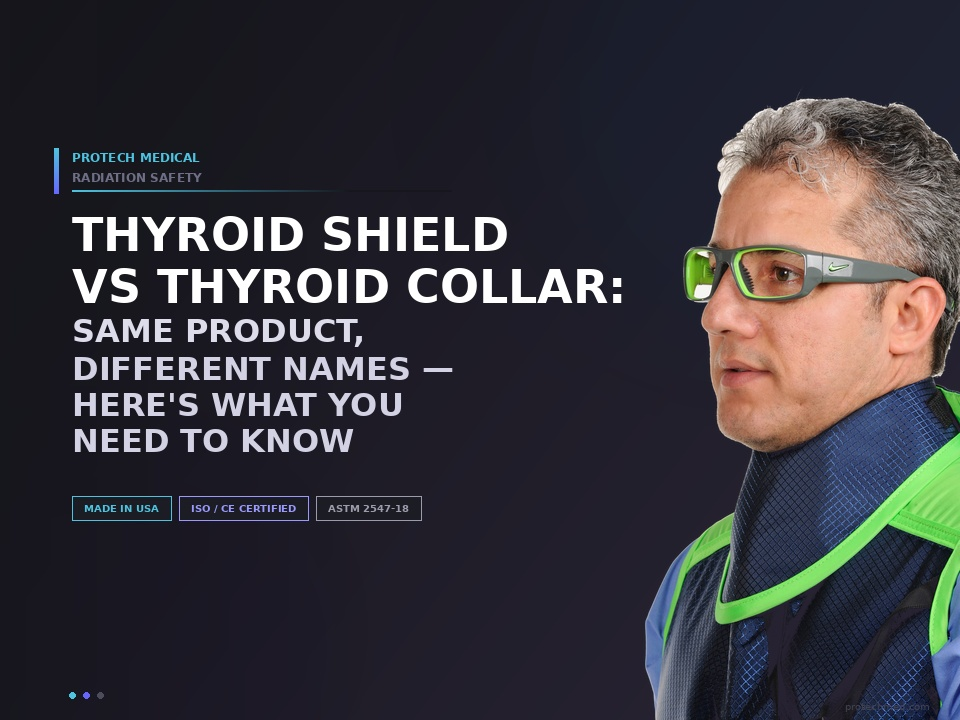
Thyroid Shield vs Thyroid Collar:
Same Product, Different Names - Here's What You Need to Know
Key Takeaways
- Thyroid shield, thyroid collar, thyroid guard, lead collar, and thyroid protector all refer to the same product.
- The naming confusion creates friction in procurement and documentation, but does not reflect any real product difference.
- Actual specifications that vary between products include lead equivalency (0.25, 0.35, or 0.50 mm Pb), core material (lead or lead-free), style, closure type, size, and outer fabric.
- 0.50 mm Pb is the clinical standard for most medical and dental applications.
- The ADA's 2024 guidance discontinued routine thyroid collar use for dental patients, but staff thyroid shielding is unchanged and remains standard occupational protection.
- Annual radiographic inspection, proper storage, and consistent disinfection protect both the shield and its protective value.
- Wherever staff cannot reliably achieve distance or structural shielding during exposure, a thyroid shield belongs on them.
Are thyroid shields and thyroid collars the same thing? To answer quickly, yes. A thyroid shield and a thyroid collar describe the same piece of personal protective equipment.
Thyroid shields are close-fitting bands of lead or lead equivalent material that wrap around the neck to attenuate scatter radiation reaching the thyroid gland during imaging procedures.
The confusion is purely linguistic. Across manufacturer catalogs, product listings routinely combine both names in a single title, such as “Thyroid Shield/Collar,” because buyers search using whichever term they learned first.
Peer-reviewed clinical literature uses the terms interchangeably, often within the same article. Similarly, “thyroid guard,” “lead collar,” and “thyroid protector” are also used interchangeably.
A few secondary distinctions do appear in catalogs, but they describe the variations within the same product category rather than different products:
- Attached vs. standalone. Some thyroid shields clip or tether to a lead apron; others are worn independently. The radiation attenuation is identical.
- Leaded vs. lead-free. Traditional lead and lead-free composite materials (generally bismuth or antimony blends) are both widely available. The stated lead equivalency, not the core material, is what determines protective performance.
- Closure type. Velcro straps, magnetic closures, and adjustable buckles differ in convenience and infection control, but not in radiation attenuation.
- Sewn-in vs. attached collar extension. Some lead aprons include an attached collar extension; a standalone thyroid shield is a separate garment worn around the neck.
Why the Terminology Matters (and Where It Gets in the Way)
The naming confusion is more than academic. It creates constant practical friction at three points in the procurement process.
Search and sourcing. A purchasing manager searching “thyroid collar” on a supplier’s site may see fewer results than someone searching for “thyroid shield” on the same site, even though the catalog is identical. This happens because the supplier indexes products under only one primary term.
Specification documents. Some state regulations and facility policies specify “thyroid collars,” while others specify “thyroid shields.” Compliance teams reading two documents side by side can reasonably wonder whether they describe the same requirement, which they do.
Inventory management. Larger facilities sometimes end up with both terms appearing in different parts of their inventory systems. One department might have ordered “collars,” while another ordered “shields,” and these two entries can look like separate product categories at audit time, even though they cover the same equipment.
Thyroid Shield vs Thyroid Collar: What Actually Varies Between Products
With the naming part settled, the real decisions in purchasing a thyroid shield come down to five specifications that genuinely differ between products.
Lead Equivalency. The single most important specification. It’s expressed in millimeters of lead (mm Pb). Three main values dominate the market:
- 0.25 mm Pb is the lightest, lowest attenuation model. It’s good for very low-scatter, brief exposure situations where permitted by facility policy.
- 0.35 mm Pb is intermediate in weight and attenuation and is suited to lower-scatter applications.
- 0.50 mm Pb is the most common clinical standard across medical and dental settings. This is the equivalency most facilities specify for routine use, and studies show thyroid shields at this level can reduce thyroid radiation exposure by up to 45 percent in typical imaging scenarios.
Unsure which lead equivalency fits your needs? Protech Medical can help you specify the right thyroid shield for your team.
Higher equivalencies are available for very high-scatter environments, but add weight without any meaningful benefit for most clinical operations.
Core material. Traditional lead remains the benchmark, but lead-free composites using tungsten, bismuth, or antimony blends have matured significantly and now deliver comparable attenuation at lower weight, with the added benefit of simpler disposal at the end of life.
For facilities with sustainability mandates or staff concerns regarding lead, lead-free thyroid shields are an effective alternative provided attenuation is documented at the relevant kVp range.
Style type. Thyroid shields vary in how they fit and what they cover. This is a specification that is often overlooked at the purchasing stage and that directly affects both protection and compliance.
- Original + Bib: Sits lower on the neck and is the most widely used for standard radiology and imaging workflows.
- Standard: Higher fit with fuller thyroid coverage. Preferred in high-scatter environments where maximum anterior protection is a must.
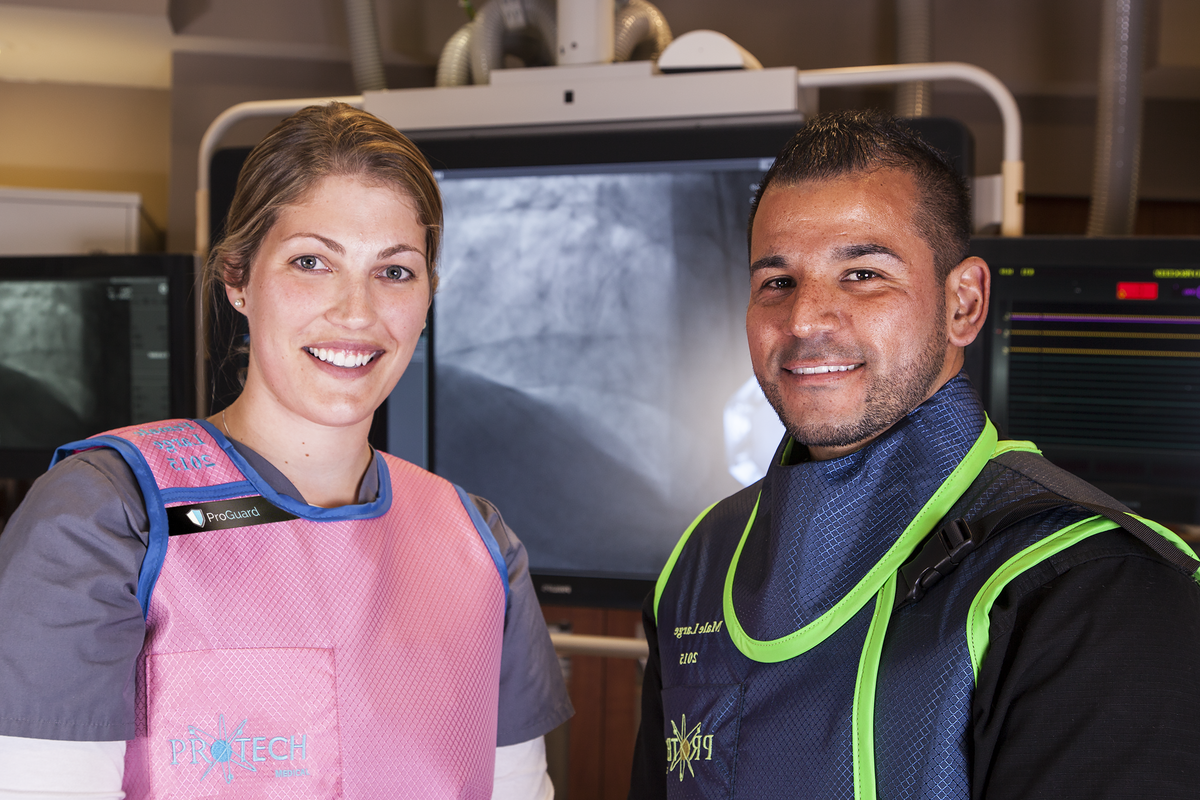
- Proguard + Visor: Front and lateral protection in a single collar. Designed for interventional procedures with elevated scatter exposure from multiple angles.
- Mammography: Low-profile design that does not interfere with mammography positioning.
- Pediatric: Sized for pediatric patients. Same 0.50 mm Pb protection in a smaller, more comfortable fit.
Closure type. Velcro is the most common closure, offering quick donning and doffing. Magnetic closures come at a slightly higher cost for faster application and easier disinfection. Buckle closures offer the most secure fit but take longer to adjust.
Size and fit. Thyroid shields are typically available in small, medium, and large based on neck circumference, with the bib length usually consistent across sizes. A poorly fitted shield that sits too loosely will allow scatter to reach the thyroid through the gap, while one that sits too tightly interferes with compliance because staff will refuse to wear it consistently.
External material. Ripstop, nylon, Satinguard, and vinyl are our external fabrics, which differ in durability, weight, and ease of cleaning. For environments with saliva or body fluid exposure, such as dental offices in particular, an outer material that tolerates frequent disinfection is non-negotiable.
These are the specifications that should drive a thyroid shield purchase. Brand recognition alone does not guarantee the necessary level of protection or comfort.
Radiation Thyroid Protection Across Clinical Settings
Thyroid shields are used across the full range of clinical environments where ionizing radiation is present, and the requirements differ by setting, which are important to consider before purchasing.
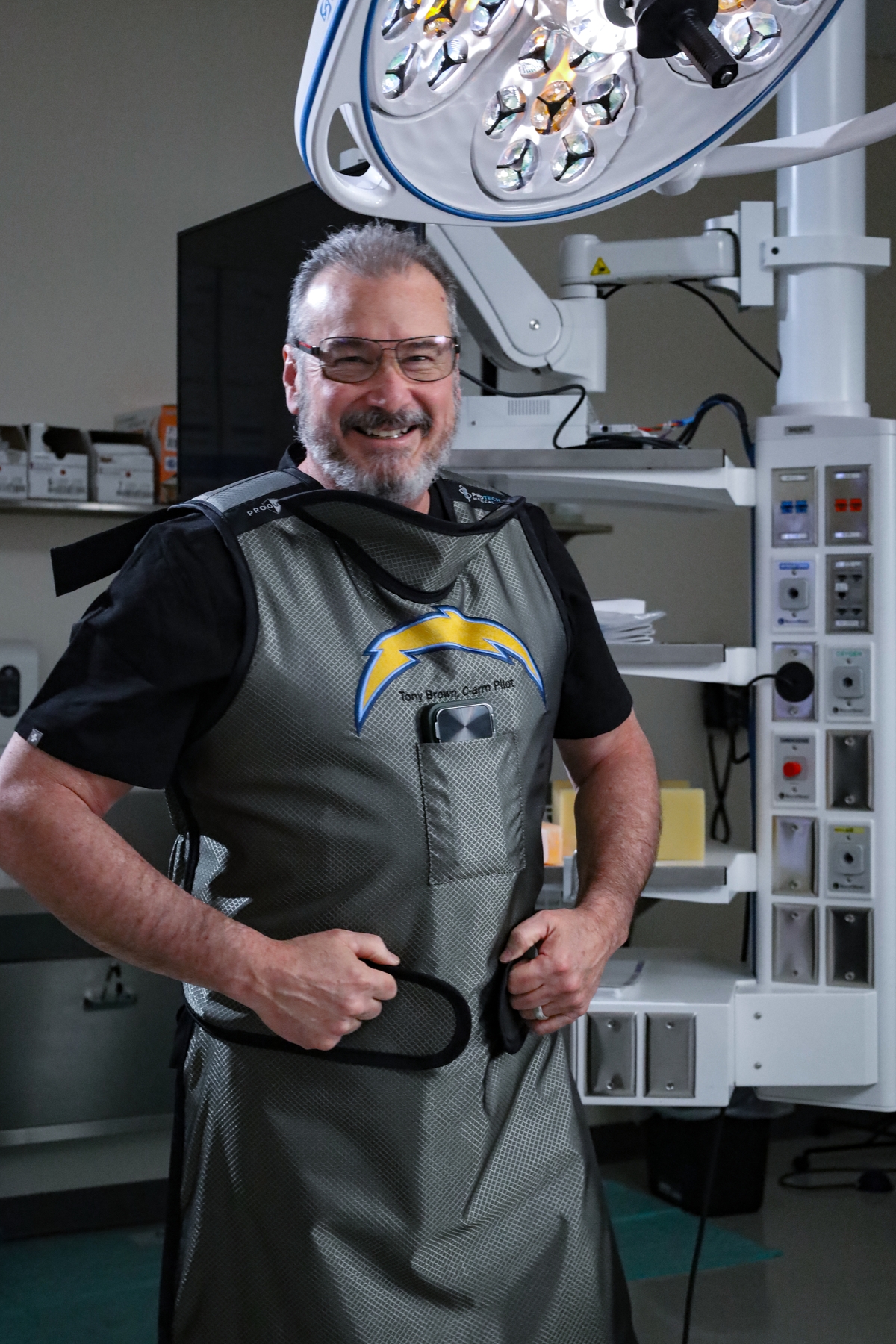
Interventional cardiology and radiology. Operators, assistants, and support staff standing within scatter range of a fluoroscopy source during cardiac catheterization, vascular procedures, and interventional radiology cases typically wear a 0.50 mm Pb thyroid shield alongside a lead apron throughout the case.
The thyroid is a highly radiosensitive organ, and a cumulative dose to the thyroid over a career of interventional practice is a well-documented occupational concern. A cumulative thyroid dose as low as 65 µSv per operation has been reported to increase long-term thyroid cancer risk, making consistent shielding a meaningful occupational health measure.
Diagnostic radiology and fluoroscopy. Technologists performing portable radiography. C-arm imaging and fluoroscopic procedures benefit from thyroid shields whenever they must remain within scatter range during exposure. Shields are standard equipment for technologists who cannot step behind a structural shield during every exposure.
Dental practice. Dental practitioners and assistants who must remain in the operatory during intraoral, panoramic, cephalometric, or CBCT imaging wear thyroid shields as part of occupational protection. CBCT is especially harmful due to the meaningful scatter and warrants consistent staff shielding.
Dental practice for patients. This is where current guidance differs from long-standing practice. The American Dental Association’s February 2024 recommendations are aligned with the Academy of Oral and Maxillofacial Radiology’s 2023 position, which discontinued routine patient thyroid collar use during intraoral, panoramic, cephalometric, and CBCT imaging, citing low doses, evidence that shielding does not meaningfully block scatter, and the retake burden caused by shields interfering with the primary beam.
Thyroid shields for patients remain appropriate where state regulations require them (such as in California) and when patients specifically ask for one. However, they are no longer the standard of care in most U.S. dental practices.
Pain management and orthopedic procedures. Pain physicians and orthopedic surgeons using C-arm fluoroscopy wear thyroid shields because their position near the patient places the thyroid within the scatter field for the entire duration of the procedure.
The common trend here is that whenever staff cannot reliably step behind a structural shield or achieve sufficient distance from the source during exposure, a thyroid shield belongs on them.
Inspection, Care, and Compliance
A thyroid shield is a small, frequently handled garment, and it sees rougher use than most protective equipment. Staff put it on dozens of times a day, pull it off between cases, and store it in whatever space is available.
That usage pattern makes inspection and maintenance particularly important.
Annual radiographic inspection. Like lead aprons, thyroid shields should be inspected annually through visual and radiographic evaluation to detect internal defects that aren’t visible from the outside. The Joint Commission expects documentation of these inspections as part of a facility's radiation safety program. Defects greater than approximately 11 mm² in a thyroid shield are the common threshold for replacement.
Daily handling. Thyroid shields should be hung on appropriate storage hooks or racks rather than folded, left crumpled in drawers, or dropped on countertops. Folding damages the internal shielding layer, and this is rarely visible until radiographic inspection reveals it.
Disinfection. Shields used in environments with saliva, blood, or other body fluid exposure require disinfection between patients. The outer shell material should tolerate the disinfectant solutions used without cracking or degrading.
Replacement cycles. A well-cared-for thyroid shield typically lasts several years. A mishandled one can develop clinically significant defects in a single year. Documented annual inspection plus proper storage typically extends service life and simplifies audit compliance.
Protech Medical’s AVA software tracks your apron and thyroid collar inventory, records group inspections, and generates Joint Commission-ready reports – free to start. Request an AVA demo
Thyroid Protection, Specified Correctly
The terminology may be interchangeable, but the purchasing decision isn’t. Lead equivalency, core material, closure type, fit, and fabric durability all shape how well a thyroid collar performs and how consistently staff actually wear it across a full shift.
Protech Medical offers thyroid collars in the lead equivalencies and materials that modern clinical environments require, from interventional suites to dental operatories. Whether your facility calls them shields or collars, the protection is built to the same standard.
Ready to specify thyroid protection that matches your clinical setting? Explore our range of thyroid shields or contact our team to discuss your facility’s requirements.
Frequently Asked Questions
Is a thyroid shield the same as a thyroid collar? Yes. The two terms describe identical products. A lead or lead-equivalent band worn around the neck to protect the thyroid from scatter radiation. "Thyroid guard," "lead collar," and "thyroid protector" are also used interchangeably. The variations between products come from lead equivalency, core material, closure type, and fit, not from the name.
What lead equivalency should a thyroid shield have? The common clinical standard is 0.50 mm Pb, which provides substantial attenuation across the kVp ranges used in medical and dental imaging. 0.25 mm Pb and 0.35 mm Pb options exist for lower-scatter applications where facility policy permits.
Are lead-free thyroid shields as effective as lead ones? When manufactured to the same lead equivalency, lead-free composite thyroid shields using tungsten, tin, or antimony blends deliver comparable attenuation at reduced weight. Verify attenuation data at the specific kVp range your department uses, and confirm the product meets applicable ASTM standards.
Do dental practices still need thyroid shields after the 2024 ADA update? Yes, for staff. The ADA's 2024 recommendation discontinued routine patient thyroid collar use during dental imaging. It did not change occupational protection requirements. Dental operators, assistants, and anyone else who must remain in the operatory during exposure continue to need thyroid shielding. Some states also still legally require patient thyroid shielding — practices in those states must continue to provide it.
How often should a thyroid shield be inspected? Annually, using both visual and radiographic inspection methods. Visual and palpation checks alone will miss small defects in the internal shielding layer. Document each inspection with the date, inspector, and pass/fail determination for audit purposes.
Can a thyroid shield be shared between staff members? Yes, provided it is disinfected between uses and the fit is acceptable for both wearers. Shared shields are common in larger departments and in dental practices. Personal shields are sometimes preferred in high-volume interventional settings where staff wear the same equipment across long cases.