

Radiation Safety for Dental Offices:
Aprons, Thyroid Shields & Patient Protection
Key takeaways
- The ADA’s 2024 radiation-safety recommendations advise discontinuing routine lead abdominal aprons and thyroid collars during dental imaging for all patients, including pregnant patients, when local law does not require them.
- Patient shielding is only one part of radiation safety. Current guidance places greater emphasis on clinical justification, using prior images when appropriate, digital receptors, rectangular collimation, careful positioning, and limiting CBCT to cases where lower-exposure options will not answer the clinical question.
- Professional guidance does not override state or local law. California Title 17 §30311 still requires a protective apron of at least 0.25 mm lead equivalent over the gonadal area for every dental radiography patient as of 2026.
- For routine intraoral and panoramic imaging, dental staff protection usually comes from room shielding and distance rather than wearing a lead apron. The IAEA states that personal protective equipment is not usually needed when the operator is appropriately positioned.
- Staff should not routinely hold patients or image receptors during exposure. When a patient truly requires support, use positioning or immobilization aids first; if a person must assist, follow applicable rules and provide appropriate protection.
Radiation protection in dentistry has changed, but not in the simple way the phrase “no more lead aprons” can make it sound. The biggest shift is in routine patient shielding. In 2024, an expert panel established by the American Dental Association Council on Scientific Affairs recommended discontinuing routine lead abdominal aprons and thyroid collars during dental radiography and cone-beam computed tomography. The recommendation applies across patient groups, including children and pregnant patients.
That change did not make radiation protection less important. It changed where the emphasis belongs. Modern dental radiation safety focuses on taking an image only when it is clinically justified, using the lowest-exposure technique that can answer the diagnostic question, controlling beam size and positioning, and protecting staff through proper room design, distance, training, and operating procedures.
There is one more complication: professional recommendations and legal requirements do not always change at the same time. Some jurisdictions still require patient shielding. A dental office therefore needs a protocol that reflects both current clinical guidance and the regulations that apply where the practice operates.
What changed in 2024 - and what changed again in 2026
The 2024 ADA recommendations, which align with the American Academy of Oral and Maxillofacial Radiology (AAOMR), state that routine abdominal and thyroid shielding should be discontinued for dental imaging. The guidance applies to intraoral, panoramic, cephalometric, and CBCT imaging.
The rationale is not that dental X-rays involve no radiation. It is that contemporary imaging techniques can keep patient dose very low, while contact shielding provides little or no additional benefit in many dental examinations. Lead aprons and thyroid collars also can enter the primary beam or obscure anatomy. If that results in a nondiagnostic image and a repeat exposure, the shield has worked against the goal of dose reduction.
The guidance also recognizes that a large share of out-of-field dose comes from scatter generated inside the patient. An external apron cannot intercept radiation that has already scattered internally. That is why beam restriction, patient positioning, receptor selection, and avoiding unnecessary images are more effective ways to reduce exposure.
In January 2026, the ADA and AAOMR added updated patient-selection recommendations for both 2-D and 3-D dental imaging. Those recommendations reinforce a patient-specific approach: obtain radiographs only when clinically necessary, make a good-faith effort to use existing images when appropriate, and use CBCT only when lower-exposure options will not provide the needed information.
The practical shift: Patient radiation protection has moved away from routine contact shielding and toward justification, optimization, beam restriction, positioning, and avoiding repeat imaging. |
How to reduce patient dose without relying on routine shielding
The most effective patient-protection steps happen before and during image acquisition, not after a shield is placed on the body.
Justify every image. Radiographs should be ordered because they are expected to improve diagnosis, treatment planning, or patient management - not simply because a fixed interval has passed.
Use existing images when they are still clinically useful. Obtaining previous radiographs can avoid unnecessary repeat imaging.
Use digital receptors when appropriate. Current ADA guidance favors digital receptors over conventional film because they can achieve diagnostic imaging at lower exposure.
Restrict the beam. Rectangular collimation should be used whenever possible for intraoral imaging. The 2024 JADA recommendations cite evidence that collimating the beam to the receptor size and shape can reduce patient dose substantially.
Position carefully. Good patient and receptor positioning reduces cone cuts, artifacts, and repeat exposures.
Use CBCT selectively. CBCT should be chosen when the diagnostic information it provides is needed and lower-exposure options will not answer the clinical question.
State law still controls what your practice must do
ADA and AAOMR recommendations are professional guidance. They do not automatically repeal state radiation-control regulations, facility policies, or other legally binding requirements.
California is the clearest example. Title 17, California Code of Regulations §30311 continues to require each patient undergoing dental radiography to be draped with a dental lead apron of at least 0.25 mm lead equivalent over the gonadal area. The current California regulatory database still lists that requirement in 2026.
That means a California dental office cannot simply stop using patient aprons because national professional guidance changed. The practice must follow the regulation until the rule itself changes or an authorized exemption applies.
The same principle applies everywhere: before changing a patient-shielding protocol, confirm the current requirements of your state radiation-control program and your facility’s written radiation-protection policy. Avoid relying on an article, vendor, or national society statement as a substitute for local compliance review.
Dental staff protection: routine PPE is usually not the first control
The original patient-shielding change should not be interpreted as an instruction to reduce occupational radiation protection. But it is equally important not to overstate what routine dental staff need to wear.
For conventional intraoral and panoramic radiography, the International Atomic Energy Agency states that personal protective equipment is not usually needed. Occupational protection is generally achieved by positioning the operator behind an appropriate protective barrier or, where a barrier is not used, maintaining distance from the patient and staying out of the primary beam.
IAEA guidance typically recommends a distance of at least 2 meters for dental facilities with intraoral and panoramic equipment when the operator is not behind shielding. For CBCT, staff should be positioned behind the protective barrier at the control console when exposures are made.
This is an important distinction: a lead apron is not a substitute for proper room design, operator position, training, or safe work practice. If an operator can make the exposure from behind a compliant barrier, that is generally preferable to standing close to the patient in protective apparel.
Typical protection approach by scenario
Scenario | Typical protection approach | Important note |
Routine intraoral or panoramic imaging | Operator behind a protective barrier, or appropriately distanced and outside the primary beam | PPE is not usually needed when the operator is properly positioned. |
CBCT | Operator behind the protective barrier/control console | Follow room-design and equipment-specific requirements. |
Patient requires physical support | Use positioning/immobilization aids first; if a person must assist, provide appropriate protection | Staff should not routinely hold patients or receptors during exposure. |
Handheld intraoral X-ray unit | Use only as cleared/intended; train staff and use the device’s backscatter shield correctly | Local rules, device instructions, and facility procedures may add requirements. |
Patient shielding required by law or policy | Use a compliant apron and position it so it does not interfere with imaging | Required lead equivalence and coverage can vary by jurisdiction. |
Holding or supporting a patient during exposure
Routine use of staff members to hold patients or image receptors should be avoided. IAEA guidance recommends using immobilization devices whenever possible and, if a person truly must provide support, using a carer or comforter rather than occupationally exposed staff where practicable.
The assisting person should be given appropriate radiation-protection instructions and protection based on the procedure and applicable rules. State requirements can be stricter. In California, for example, occupationally exposed individuals are not permitted to hold patients or films during exposure.
This is why a blanket rule such as “keep two or three staff aprons by the door” is not a sound radiation-safety protocol. The better approach is to design the workflow so staff do not need to remain close to the patient during an exposure, then address the uncommon exceptions deliberately.
What about handheld dental X-ray units?
Handheld intraoral X-ray systems deserve separate attention because the operator remains with the device during exposure. These units should be FDA-cleared for their intended use and operated in accordance with the manufacturer’s instructions, including correct use of the integral backscatter shield.
The 2024 ADA recommendations specifically call for staff training on the proper handling of handheld devices. State and facility requirements may also address operator positioning, storage, dosimetry, and protective apparel. Do not assume that the protection plan for a wall-mounted intraoral unit automatically applies to a handheld system.
When dental lead aprons and thyroid shields are still required
The change in national guidance does not make dental aprons obsolete. Patient shielding may still be required by state law, facility policy, or a specific clinical workflow. Practices may also encounter patients who are accustomed to shielding and have questions about why the protocol has changed.
When patient shielding is required, choose the garment around the actual requirement: coverage, lead equivalence, adult or pediatric sizing, exam type, and whether a thyroid collar is permitted or appropriate for that imaging geometry. A shield should never be positioned so that it obstructs the area being imaged.
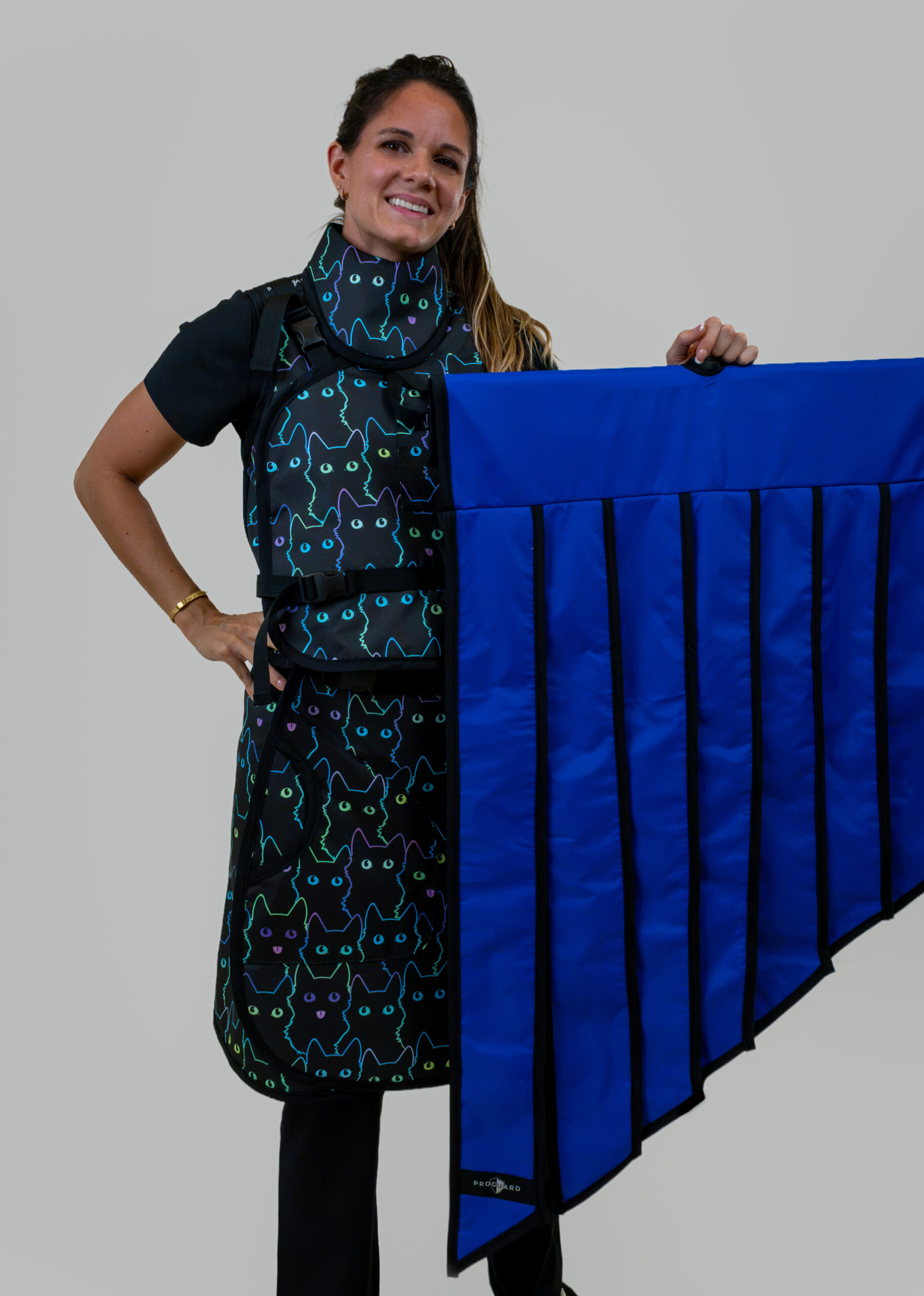
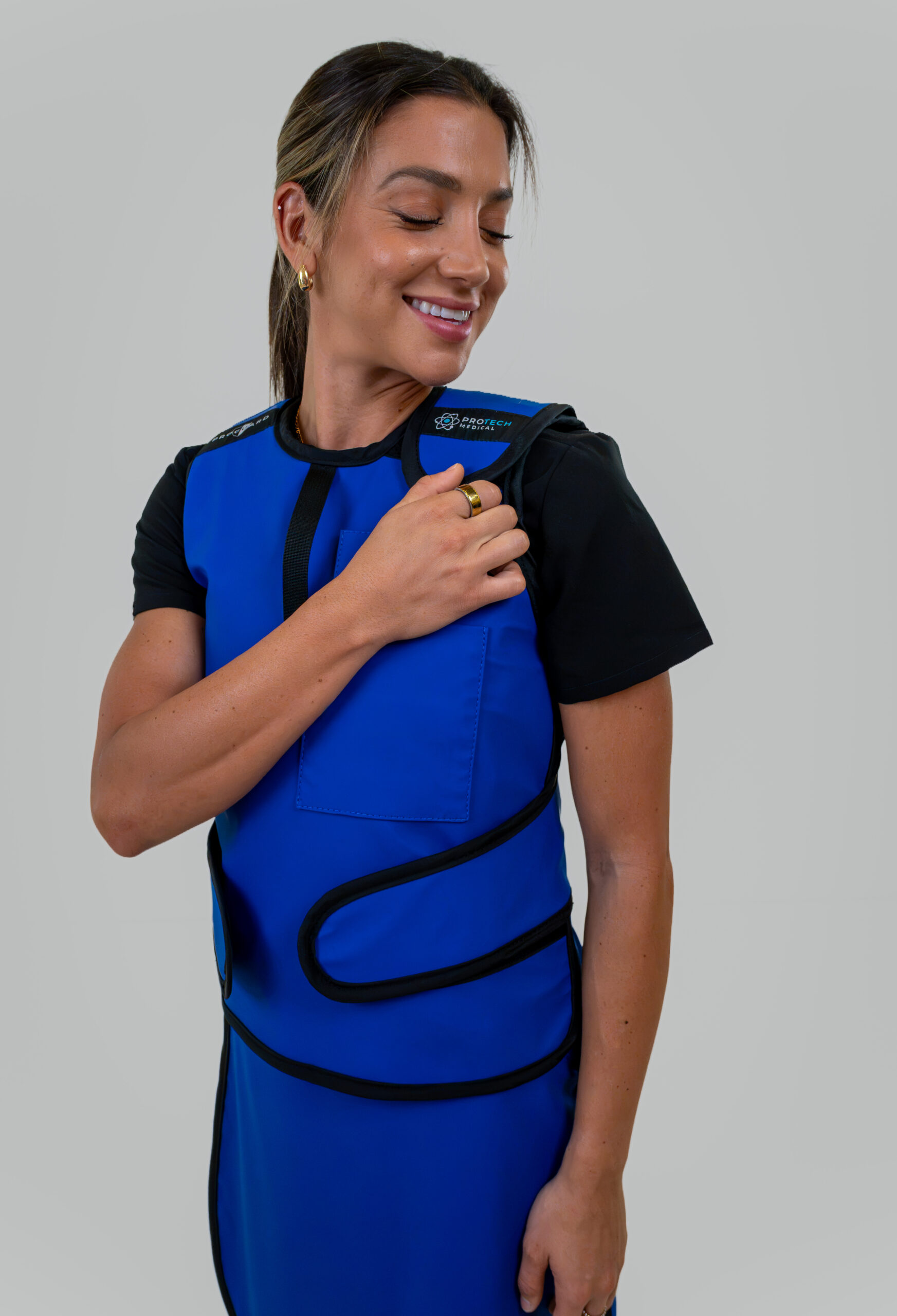
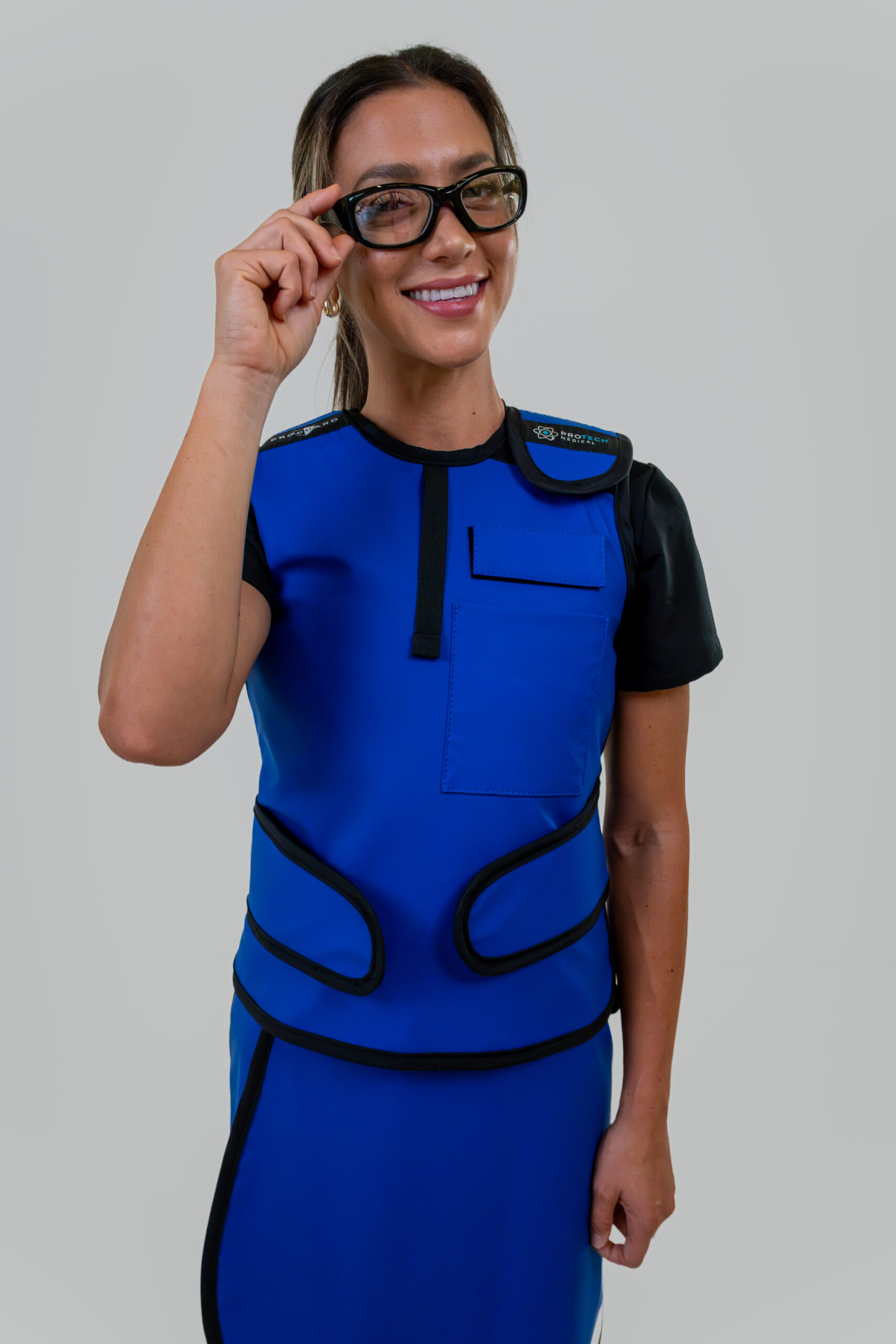
Protech offers dedicated dental lead aprons, panoramic ponchos, and attached thyroid collars and shields in adult and pediatric sizes, with options that include attached thyroid protection where applicable. These products remain appropriate for facilities and jurisdictions that require or choose to maintain patient shielding under an approved protocol.
Storage, care and inspection
Radiation-protective apparel should be stored in a way that avoids unnecessary folding, creasing, or compression of the protective core. Use an appropriate apron hanger or store the garment flat according to the manufacturer’s instructions. Dental lead aprons and thyroid shields should be stored so the protective core material is not folded, creased, or compressed.
Inspect protective apparel according to the manufacturer’s instructions and your facility’s radiation-safety program. If a garment is damaged or its protective integrity is in question, remove it from routine use until it can be evaluated. Cleaning and disinfection should also follow material-specific instructions so the exterior and protective core are not damaged.
A practical dental radiation-safety checklist
- Order imaging only when it is clinically justified.
- Review existing images before repeating an examination.
- Use digital receptors and appropriate exposure settings.
- Use rectangular collimation whenever possible for intraoral imaging.
- Position the patient and receptor carefully to reduce repeat exposures.
- Confirm current state and local requirements before changing patient-shielding practices.
- Keep operators behind protective barriers or appropriately distanced and outside the primary beam.
- Do not routinely use staff members to hold patients or image receptors during exposure.
- Treat handheld X-ray systems as a separate workflow with device-specific training and controls.
- Document the practice’s radiation-protection procedures and train staff consistently.
The goal is not more shielding - it is better radiation protection
The 2024 shielding recommendations are best understood as a change in method, not a retreat from radiation safety. For patients, the strongest protection comes from justified imaging, beam restriction, proper technique, and avoiding repeat exposures. For dental staff, the strongest routine controls are room shielding, distance, operator position, and training.
Where state law or facility policy still requires patient shielding, follow it. Where shielding is not required, use the current ADA and AAOMR recommendations to build a patient-centered protocol and explain the change clearly. The right policy is the one that combines current evidence, applicable regulations, and a workflow that keeps unnecessary exposure as low as reasonably achievable.
Frequently asked questions
Do dental X-ray patients still need lead aprons?
Under the ADA’s 2024 guidance, routine lead abdominal aprons are no longer recommended for dental imaging, including intraoral, panoramic, cephalometric, and CBCT procedures. State or local law can still require them, so practices should confirm the rules that apply in their jurisdiction.
Does the recommendation also apply during pregnancy?
Yes. The ADA and AAOMR recommendations apply to pregnant patients as well as other patient groups. Pregnancy does not create a separate routine-shielding recommendation for dental imaging, although local regulations still apply.
Does California still require a dental lead apron?
Yes. As of 2026, California Title 17 §30311 still requires a protective apron of at least 0.25 mm lead equivalent over the gonadal area for each patient undergoing dental radiography.
Do dental staff need to wear lead aprons during routine X-rays?
Usually not when conventional dental radiography is performed from behind an appropriate protective barrier or at an appropriate distance outside the primary beam. PPE needs should be determined by the actual equipment, workflow, facility radiation-protection program, and applicable regulations.
Should staff wear thyroid collars during routine dental radiography?
There is no universal requirement for routine dental operators to wear thyroid collars when they are properly protected by barrier and distance. Thyroid protection may be appropriate in specific exposure scenarios or may be required by a facility or jurisdiction.
What if a patient asks for a lead apron?
Explain the current professional guidance and follow state law and your facility policy. If shielding is used, it should be positioned so it does not interfere with the image or create a need for repeat imaging.
Should dental offices get rid of their aprons?
Not necessarily. Some jurisdictions still require patient shielding, and certain workflows may still call for protective apparel. Keep an inventory that matches your legal requirements and approved radiation-protection procedures rather than stocking aprons based on a universal rule.

Let's talk Protech-tion |
Or call 561.627.9769 to get started.
References
- American Dental Association - 2024 radiation safety recommendations - https://www.ada.org/about/press-releases/ada-releases-updated-recommendations-to-enhance-radiography-safety-in-dentistry
- JADA - Optimizing radiation safety in dentistry: Clinical recommendations and regulatory considerations - https://www.sciencedirect.com/science/article/pii/S0002817723007341
- American Dental Association - 2026 patient-selection recommendations - https://www.ada.org/about/press-releases/new-recommendations-confirm-dental-x-rays-most-effectively-used-in-moderation
- AAOMR - Patient shielding during dentomaxillofacial radiography - https://pubmed.ncbi.nlm.nih.gov/37530694/
- IAEA - Radiation Protection in Dental Radiology - https://www-pub.iaea.org/MTCD/Publications/PDF/PUB1972_Web.pdf
- California Code of Regulations - Title 17, §30311 - https://govt.westlaw.com/calregs/Document/IBE317B935A2011EC8227000D3A7C4BC3
- Protech Medical - 2026 Radiation Safety Apparel Catalog - https://protechmed.com/wp-content/uploads/Protech-Medical_Apron-Catalog-2026-WEB-compressed.pdf