
Cath Lab Radiation Safety:
Full PPE Guide for Interventional Teams
KEY TAKEAWAYS
- Cath lab staff can receive meaningful cumulative occupational exposure because they work close to the patient during fluoroscopy, where the patient is the principal source of scatter radiation.
- Modern guidance emphasizes layered protection: optimize imaging technique and room shielding first, then use properly selected PPE for staff who remain in the scatter field.
- For interventional work, commonly used protection includes a lead-equivalent apron, thyroid protection, radiation-protective eyewear, and personal dosimetry. Radiation-attenuating gloves are situational and should never be used as a reason to place hands in the primary beam.
- The 2026 ALARA framework expands the traditional ALARA principle to address both radiation exposure and the musculoskeletal burden of heavy protective equipment.
- Apron fit, coverage, material, and work geometry matter as much as a single lead-equivalence number. Lighter materials can reduce ergonomic burden, but performance should be matched to the beam energies and procedures actually used.
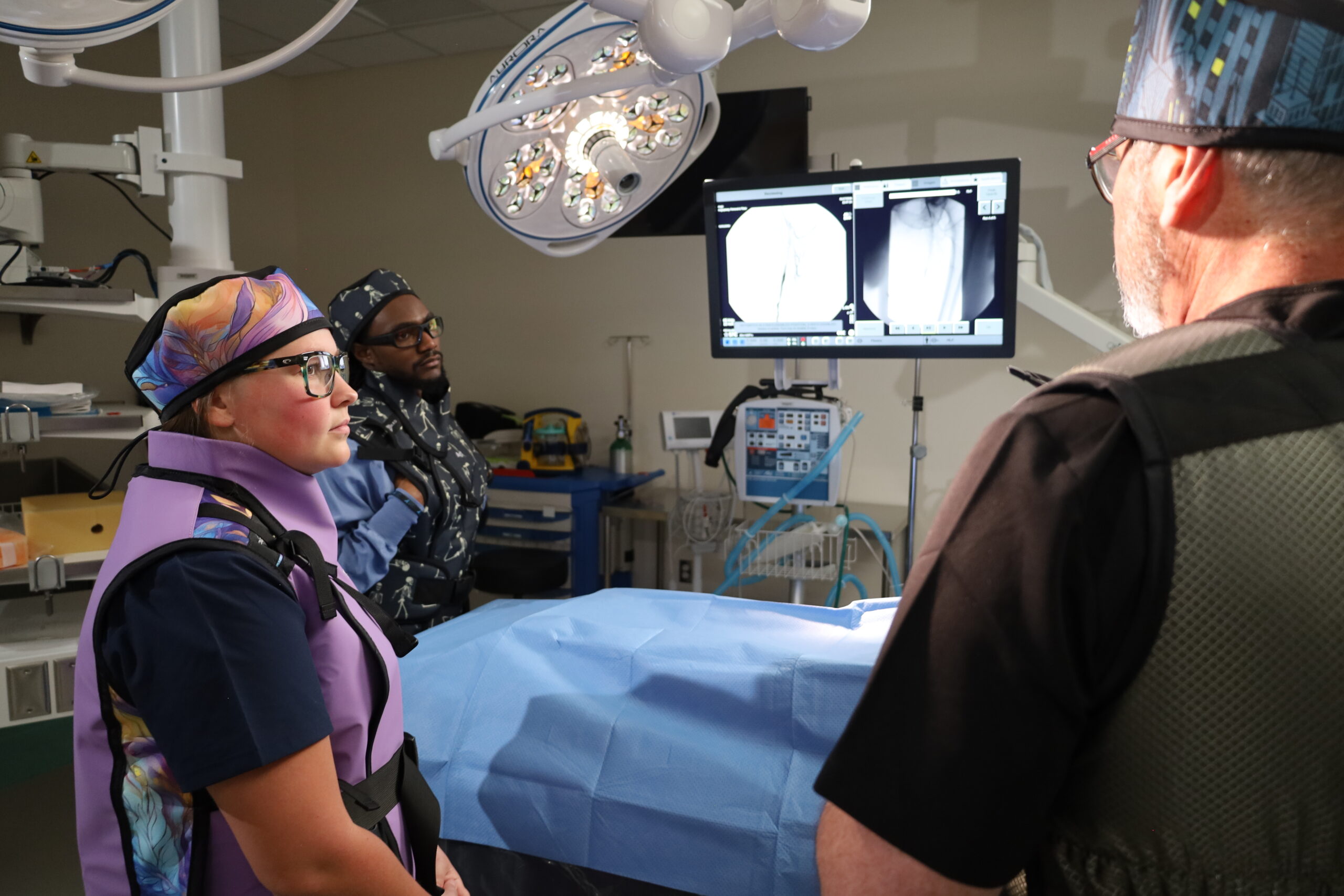
Cath lab radiation safety is not a single-product problem. During fluoroscopy, interventional teams work close to the patient, and the patient is the main source of the scattered X-radiation reaching staff. The IAEA identifies interventional radiology and interventional cardiology among the medical practices associated with the highest occupational doses, alongside nuclear medicine. [3][4]
The other occupational hazard is physical. A 2023 SCAI survey found that roughly two-thirds of interventional cardiologists reported musculoskeletal pain related to cath lab work or radiation-protection equipment. In 2026, nine medical societies endorsed ALARA+, or "As Low and As Light as Reasonably Achievable," to address both radiation exposure and the orthopedic burden of protection. [1]
The goal is not simply to add more lead. It is to build a system in which imaging technique, shielding, distance, PPE, dosimetry, and ergonomics work together.
Why cath lab radiation exposure requires special attention
Most occupational exposure in fluoroscopy comes from scatter generated when the primary X-ray beam interacts with the patient. The amount and direction of that scatter change with patient size, beam angulation, field size, dose mode, fluoroscopy time, cine acquisition, table position, and shielding. Reducing patient dose generally reduces staff scatter as well. [4]
Cath lab operators work close to the patient. They cannot step behind structural shielding for every exposure. Complex PCI, chronic total occlusion procedures, structural heart interventions, and some electrophysiology cases can involve prolonged or repeated fluoroscopy. Cumulative exposure can rise with beam-on time, image acquisition, dose rate, and unfavorable geometry.
That exposure is not distributed evenly across the body. The eyes, head, neck, hands, and lower extremities can receive scatter that is not fully addressed by a torso apron. This is why modern cardiac cath lab radiation protection should be planned as a layered system rather than a single garment.
ALARA+ changes the conversation
In March 2026, a multisociety summit formalized ALARA+ - "As Low and As Light as Reasonably Achievable." It keeps the goal of minimizing radiation exposure while explicitly recognizing the orthopedic strain created by heavy protective garments. Nine medical societies endorsed the framework. [1]
ALARA+ is a professional framework, not a product endorsement. It does not make the lightest apron or any particular shielding system a universal standard; it asks departments to reduce radiation exposure while also considering physical burden.
In July 2026, a SCAI/ASE/HRS/SIR/SVS expert consensus statement called for broader implementation of enhanced radiation-protection technologies while avoiding endorsement of any single system. [2] The practical takeaway: engineer protection into the room and workflow where feasible, with PPE as an additional layer for personnel who remain exposed to scatter.
Start with the room: engineering and in-room shielding
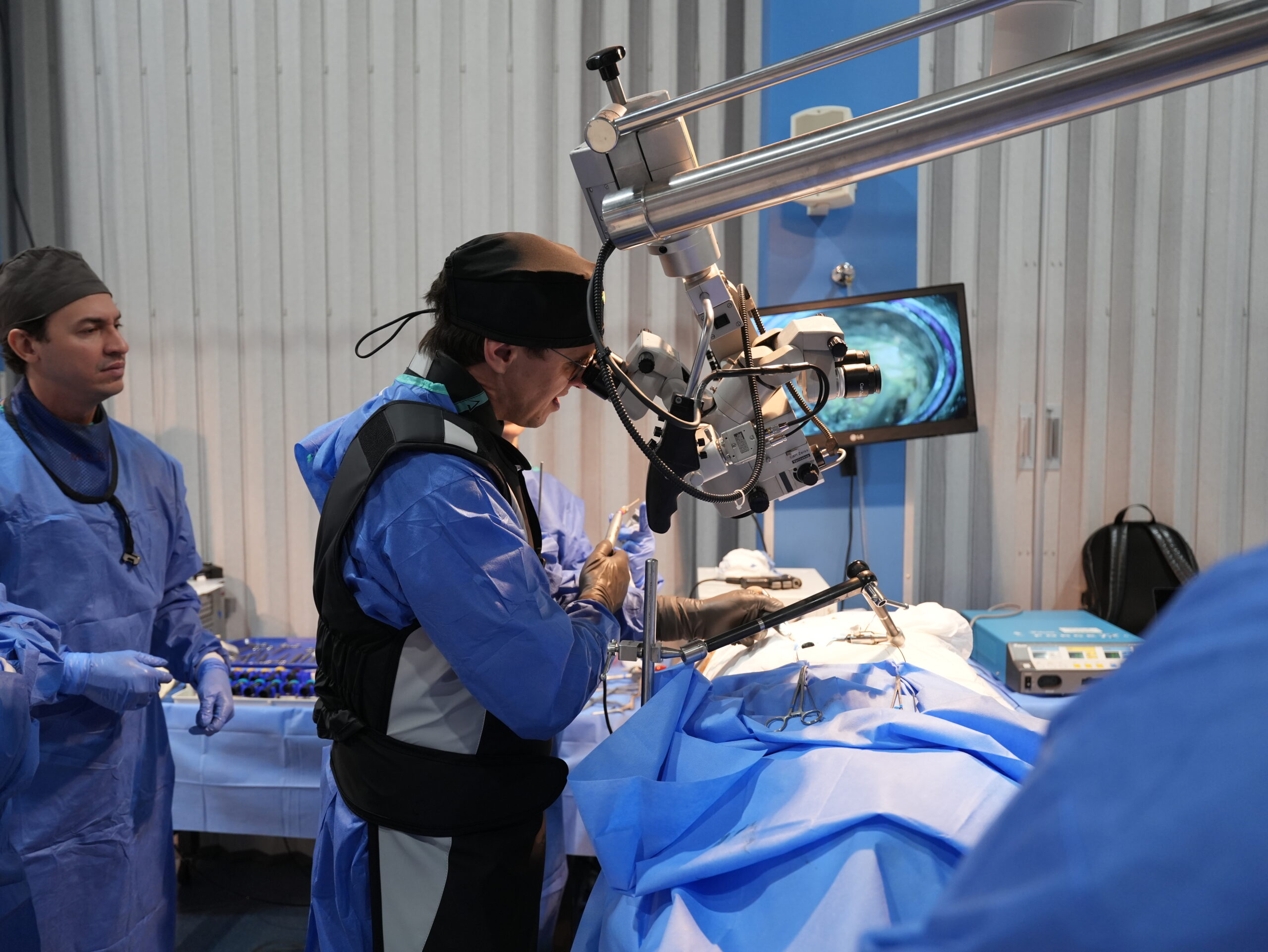
PPE matters, but it should not carry the full burden of cath lab radiation protection. Ceiling-suspended shields, table-side or under-table curtains, movable barriers, and other enhanced radiation-protection devices can intercept scatter before it reaches personnel. Their effectiveness depends heavily on positioning and procedure geometry. A shield that is several inches out of position or left behind when the C-arm angle changes may provide far less benefit than expected.
Ceiling and table shielding can create protected zones for more than one team member when geometry permits. Mobile barriers can add protected positions for nurses, technologists, anesthesia personnel, or others who can work behind them without losing access to the patient.
Sterile patient-mounted radiation-attenuating drapes may also reduce scatter in selected procedures. They should be treated as a supplemental layer, not a substitute for proper equipment-mounted shielding, mobile barriers, PPE, or good imaging technique.
Cath lab PPE and monitoring checklist
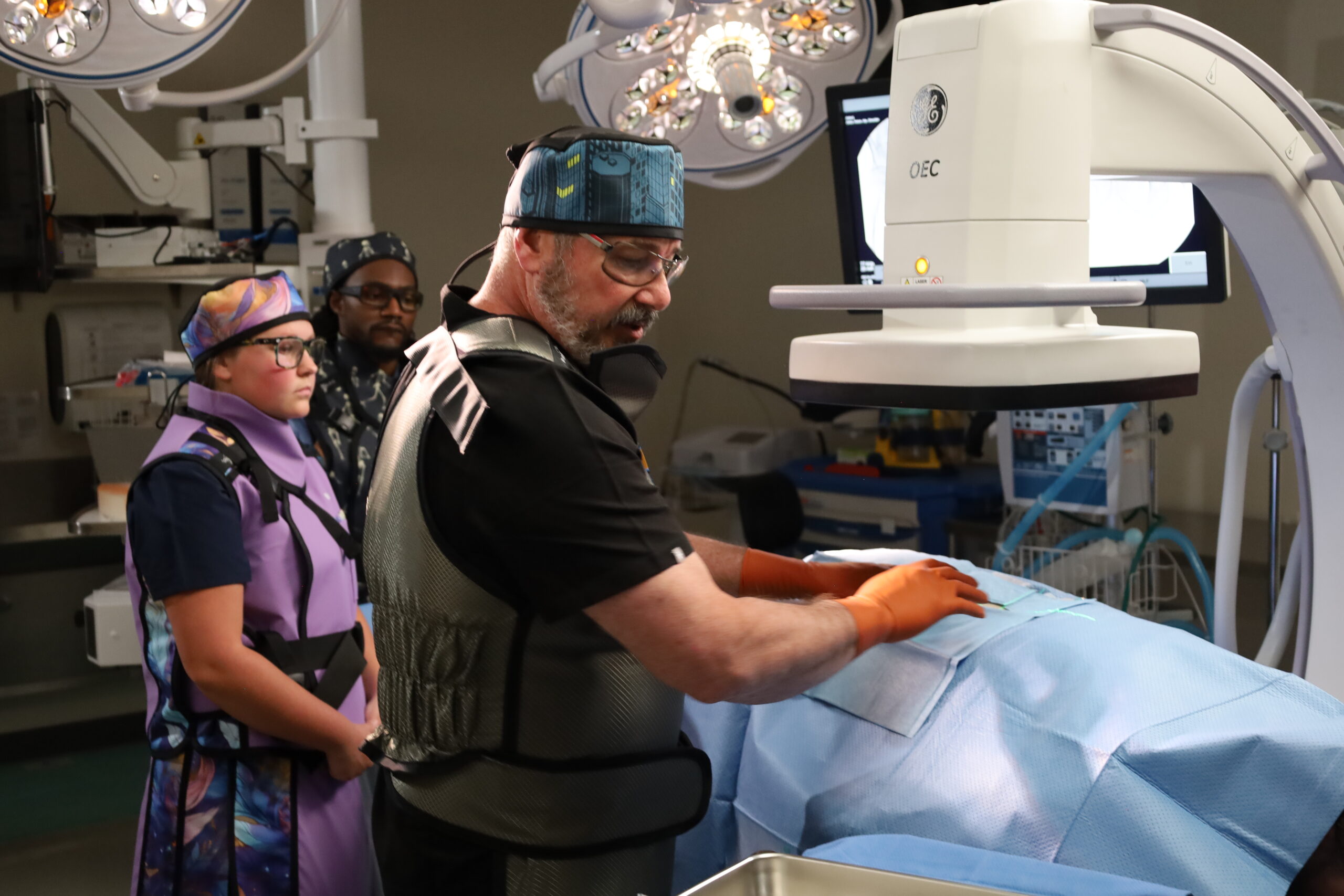
The exact requirements depend on facility policy, state or national regulations, the procedure, and the recommendations of the radiation safety officer or medical physicist. For staff who routinely work near fluoroscopy, the following items are commonly part of the protection program. Cath lab PPE only works when each item is selected for the role and verified before the case.
Item | What to look for | Technical note |
Protective apron | Coverage, fit, lead equivalence, material, weight distribution | IAEA guidance for image-guided interventional work favors wraparound protection, preferably a vest-skirt configuration to distribute weight. Facility-specific protection levels still apply. [3] |
Thyroid protection | Close fit and adequate neck coverage | The thyroid is not protected by a standard torso apron. Interventional guidance commonly includes separate or integrated thyroid protection. [3] |
Radiation eyewear | Frontal and lateral coverage, close fit, prescription compatibility | Eye-lens exposure is a recognized concern in interventional work; frame geometry and side coverage influence protection. [3][4] |
Personal dosimetry | Correct number and placement of badges for the role | A dosimeter measures exposure; it is not PPE. IAEA guidance recommends two dosimeters for image-guided interventional procedures, subject to national and facility protocols. [3] |
Attenuating gloves | Sterile, tactile, tested attenuation, appropriate indication | Useful for scatter reduction when hands are near but outside the primary beam. They should not encourage hand placement in the beam. |
Optional supplemental PPE | Head protection or additional garment coverage based on risk | Not universal requirements. Selection should be driven by procedure, staff position, measured dose, and the facility radiation-safety program. |
Choosing a cath lab lead apron: coverage, fit, and weight
There is no single best apron for every cath lab role. Coverage should follow actual work geometry, including how close the wearer works to the patient and whether the wearer frequently turns away from the source of scatter.
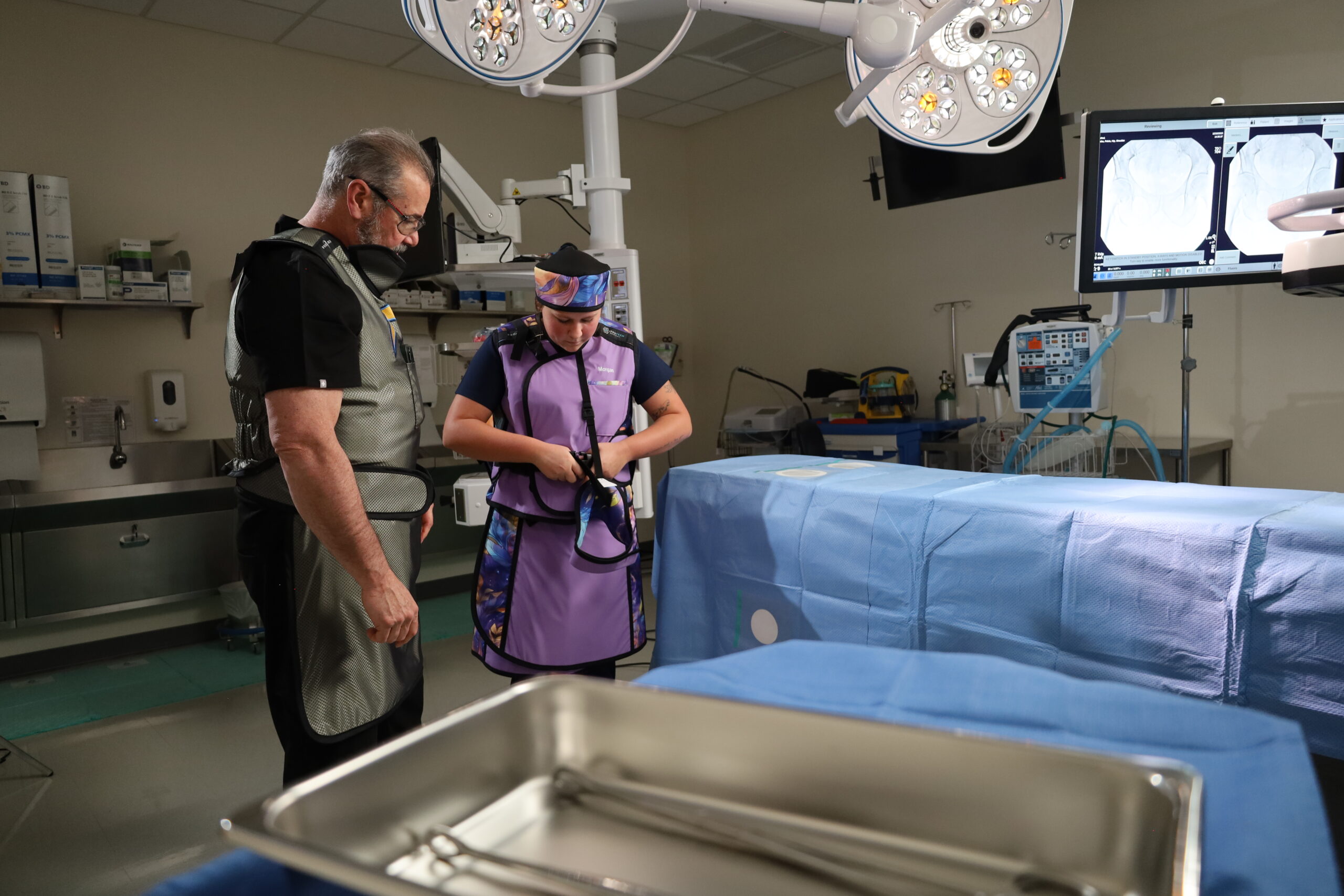
For image-guided interventional procedures, IAEA guidance specifically favors wraparound aprons and preferably vest-skirt designs because the two-piece configuration spreads the load. [3] That aligns well with an ergonomic goal that matters in high-volume cath labs: reducing the amount of weight carried entirely by the shoulders and spine.
Protech's Balance Vest-Skirt is designed to shift approximately 70% of the garment weight to the hips. [7] That figure is a Protech product-design claim, not a universal property of every vest-skirt apron. Proper sizing still matters; a poorly fitted two-piece garment can create its own pressure points, gaps, or uneven load distribution.
Core material is another part of the equation. Lead provides broad attenuation across diagnostic X-ray energies but is the heaviest option. Protech's Nano core is approximately 33% lighter than standard lead and is optimized for approximately 80-100 kV. Prolite Bilayer IEC is heavier than Nano but is designed for a broader 60-150 kV range. [6] These materials should be compared by tested attenuation at the beam energies relevant to the lab - not by weight alone.
Core option | Published range | Why it may matter |
Standard Lead | 50-150 kV | Broad energy range and consistent attenuation; highest weight of the listed options. |
Prolite Bilayer IEC | 60-150 kV | Broader energy range than the lightest lead-free options, with less weight than standard lead. |
Nano | 80-100 kV | Protech's lightest core; approximately 33% lighter than lead by published area-density comparison. |
Leaded eyewear: coverage matters as much as the lens
The lens of the eye is radiosensitive, and cataract risk is a well-established occupational concern in interventional fluoroscopy. Protective eyewear works best when the frame fits close to the face and limits exposure from oblique angles. A high lead-equivalent lens in a poorly fitting frame can leave meaningful gaps at the sides or beneath the lens. Leaded eyewear is sometimes called lead glasses.
For cath lab staff, look for lateral coverage through a wraparound design or side shielding, a stable fit that does not slide during a case, and prescription compatibility when needed. Protech manufactures leaded eyewear in the U.S. and supports prescription lenses through its in-house optical operation, which can be useful for teams that need radiation protection without giving up corrective vision.
Radiation-attenuating gloves: useful, but easy to misuse
Radiation-attenuating gloves are designed to reduce scatter reaching the hands; they are not permission to place the hands in the primary beam. When a glove enters the primary beam and covers the region used by the fluoroscope's automatic exposure or brightness-control system, the system may increase tube output to compensate for the added attenuation. That can increase patient dose and scatter while defeating the purpose of the glove.
The safer rule is simple: keep hands out of the primary field whenever the procedure allows. Use attenuating gloves when the hands must work near the field and the facility's radiation-safety program supports their use. Protech's Proguard RR glove is a sterile, single-use, latex-free lead-oxide glove intended to reduce scattered radiation exposure to the hands. Protech also offers lead-free glove options; model-specific attenuation and materials should be reviewed before selection. [8]
Dosimetry: measure the exposure you are trying to manage
A dosimeter is not protective equipment; it is a measurement tool. Correct placement is essential for meaningful results.
IAEA guidance recommends two dosimeters for image-guided interventional procedures: one outside the apron at shoulder or collar level on the side closest to the radiation source, and a second under the apron on the torso, subject to national requirements and the facility's monitoring program. [3] Some staff may also require eye-lens or extremity monitoring based on role and expected dose. The medical physicist or radiation safety officer should define placement and review results for trends, unusual readings, or opportunities to improve technique.
ALARA in practice: technique still matters
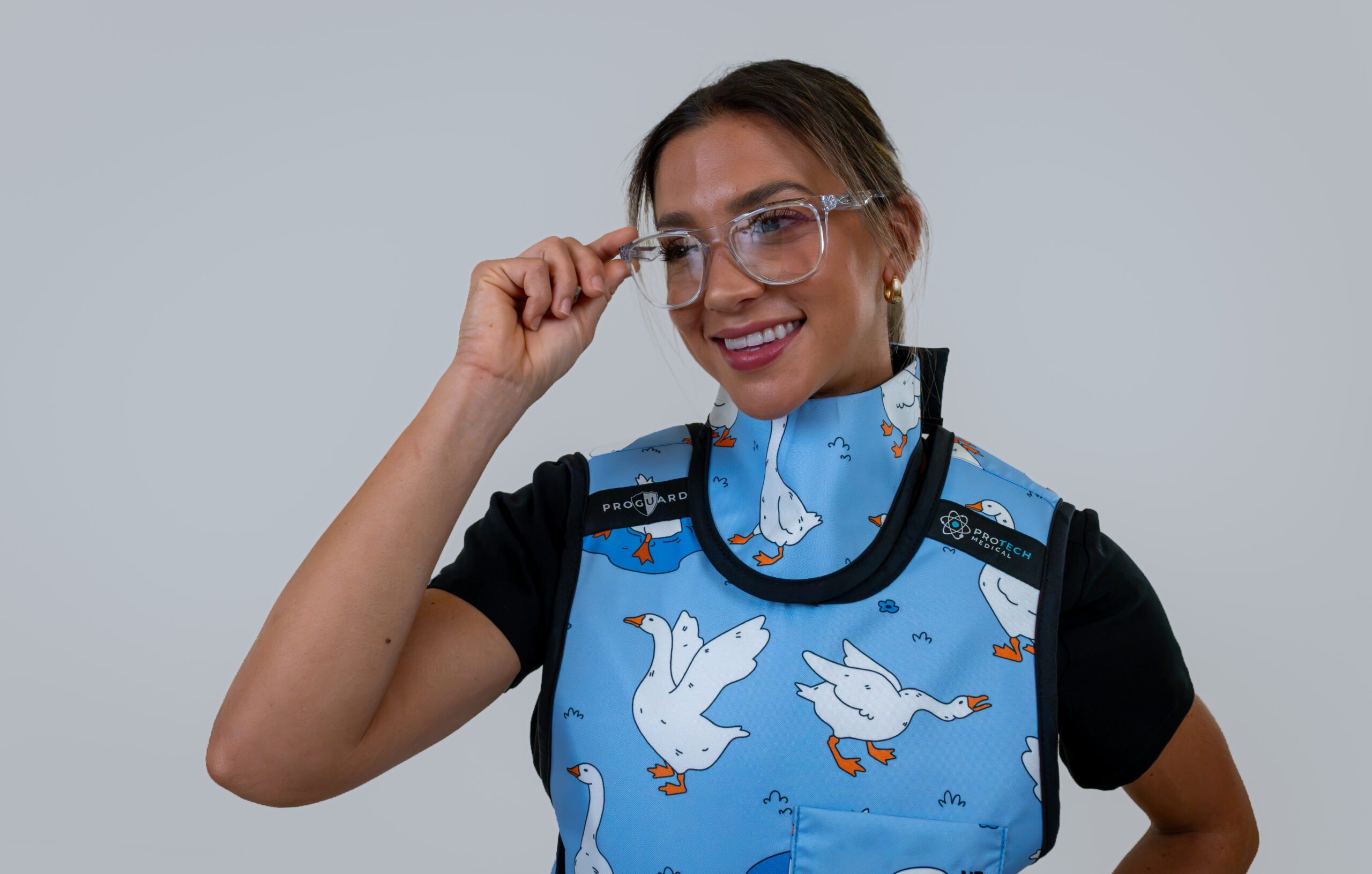
Even the best PPE cannot compensate for poor fluoroscopy practice. Staff dose is closely tied to patient dose and scatter, so operational choices matter.
- Use the lowest fluoroscopy pulse rate and dose mode that provides adequate image quality for the task. In a randomized study of transradial coronary procedures, 7.5 frames per second versus 15 frames per second reduced operator dose by 30% and patient dose-area product by 19%. That result is procedure- and equipment-specific, so it should not be treated as a universal 30% guarantee. [5]
- Minimize unnecessary beam-on time and image acquisition. Fluoroscopy time alone does not describe total dose, but avoiding unnecessary exposure remains fundamental.
- Use collimation and appropriate imaging geometry. Beam angulation and field size can significantly change scatter around the patient.
- Increase distance when workflow permits. Staff exposure generally falls quickly as distance from the patient increases, even though the patient is an extended scatter source rather than a perfect point source.
- Reposition shielding when the table, C-arm, patient, or staff position changes. A protected zone is only useful while the geometry still supports it.
- Review dosimetry and dose reports as a team. Radiation safety improves when unusual readings lead to training or workflow changes rather than simply being filed away.
Pre-procedure cath lab radiation-safety check
- Confirm ceiling-suspended and table-side shielding is positioned for the planned access site and working geometry.
- Confirm mobile barriers or other protected positions are available for staff who can work away from the table.
- Check that each required apron fits properly, closes correctly, and has no obvious damage.
- Confirm thyroid protection and radiation-protective eyewear are available and appropriately fitted.
- Verify personal dosimeters are present and worn in the positions specified by the facility radiation-safety program.
- Review whether attenuating gloves or other procedure-specific protection is indicated; do not plan hand placement in the primary beam.
- Use appropriate low-dose fluoroscopy settings, pulse rate, collimation, and imaging geometry for the procedure.
- Reassess shielding whenever the C-arm, table, or team position changes.
Build a system, not a pile of PPE
The strongest cath lab radiation-safety program does not ask a lead apron to solve everything. It reduces scatter at the source, uses shielding effectively, selects PPE for the actual role, monitors occupational dose, and considers ergonomic burden.
That is also the practical value of ALARA+. Protection should be as low in radiation exposure and as light in physical burden as reasonably achievable - without trading away attenuation, coverage, fit, or clinical workflow. [1]
Protech manufactures custom Proguard radiation-protective apparel in South Florida and offers a broader portfolio of leaded eyewear, radiation-attenuating gloves, mobile barriers, table shielding, and scatter-reduction products. For a cath lab program, the right conversation is not simply which product has the biggest number on the spec sheet. It is which combination of products and practices fits the room, the beam energies, the staff positions, and the procedures being performed.
Frequently asked questions
What PPE is required in a cath lab?
There is no single universal list that applies to every staff role or jurisdiction. For personnel who routinely work near fluoroscopy, common protection includes a lead-equivalent apron, thyroid protection, radiation-protective eyewear, and personal dosimetry, backed by appropriate room shielding. Gloves and supplemental head or body protection are procedure- and risk-dependent. Facility policy, applicable regulations, and the medical physicist or radiation safety officer should set the final requirements.
Does every cath lab apron have to be 0.5 mm lead equivalent?
Not every jurisdiction or role is governed by the same rule. International guidance for image-guided interventional work commonly uses 0.5 mm lead equivalent as a reference level because of the higher scatter environment, but facility and regulatory requirements vary. Material performance also changes with beam quality, so attenuation data and the relevant kV range matter in addition to nominal lead equivalence.
Do radiation-attenuating gloves work during fluoroscopy?
They can reduce scatter reaching the hands when used near but outside the primary beam. They should not be used to justify placing hands in the primary field. If an attenuating glove enters the field, automatic exposure control may increase X-ray output, which can increase patient dose and scatter.
How often should cath lab lead aprons be inspected?
Inspect garments visually and physically as part of routine use and after any event that could damage them. Imaging-based integrity checks should follow the facility's quality-assurance program, manufacturer instructions, and radiation-safety or medical-physics guidance rather than relying on one universal interval for every institution.
What is ALARA?
ALARA stands for "As Low and As Light as Reasonably Achievable." The 2026 multisociety framework expands traditional ALARA by considering both ionizing-radiation exposure and the musculoskeletal burden of protective equipment. It does not endorse a specific apron, material, or shielding product; it encourages safer systems that address both hazards.
Does lowering fluoroscopy from 15 to 7.5 frames per second always reduce operator dose by 30%?
No. A randomized transradial coronary study reported a 30% relative reduction in operator dose under its specific equipment settings and study conditions. Lower pulse rates generally reduce dose when image quality remains adequate, but the exact reduction depends on equipment, protocol, procedure, patient, and imaging settings.
Let's talk Protech-tion |
Or call 561.627.9769 to get started.