
Breast Cancer Awareness Month:
Protecting Women From Scatter Radiation at Work
Key takeaways
- October is Breast Cancer Awareness Month. For women who work around medical imaging, breast health is also an occupational question, because scatter radiation reaches the body standing beside the patient.
- Scatter radiation is the secondary radiation that bounces off the patient during fluoroscopy and imaging, and it can reach staff from the side as well as the front (NRC, NCRP).
- The science here is about association, not causation. Research describes patterns of occupational exposure among interventional staff, not proof that apparel prevents cancer. Protection reduces exposure, it does not prevent disease.
- Women lower occupational exposure the same way every team does: a well-fitted apron, targeted axillary protection worn underneath, distance from the source and shielding.
- Protech joined the American Cancer Society Making Strides Against Breast Cancer walk on Oct 24, 2026. This article is educational and is not medical advice.
Every October the pink ribbons go up, and most of the conversation is about screening and early detection. That matters. For women who spend their working lives beside an X-ray beam, there is a second conversation worth having, and it gets far less attention. Interventional cardiologists and radiologists, cath lab and surgical teams, rad techs, dental and veterinary staff all work in scatter radiation, and some of that scatter reaches the chest. This piece looks at what scatter radiation is, what the evidence does and does not say about it, and the practical ways women reduce their exposure at work. It is educational, not medical advice. Your facility Radiation Safety Officer and your physician are the people who guide your own decisions.
What is scatter radiation, and why the breast and axillary region
Scatter radiation is the secondary radiation that comes off the patient. When the primary X-ray beam strikes the patient during fluoroscopy or imaging, some of that energy bounces in every direction, including back toward the people in the room. The patient is effectively the main source of radiation that reaches staff, and that dose falls off quickly with distance. This is the central idea in occupational radiation safety, and it is why protective apparel exists: the garment is designed to attenuate scatter before it reaches the body.
Interventional and imaging staff are among the most exposed healthcare workers because they stand close to that scatter source for long cases, day after day. Occupational dose is governed by regulatory limits and by the ALARA principle, which stands for as low as reasonably achievable. In the United States the Nuclear Regulatory Commission sets an annual occupational whole-body dose limit of 50 mSv (5 rem) per year, described in the NRC occupational dose limits under 10 CFR 20.1201. For the broader clinical context of managing dose during fluoroscopically guided procedures, NCRP Report No. 168 remains a standard reference.
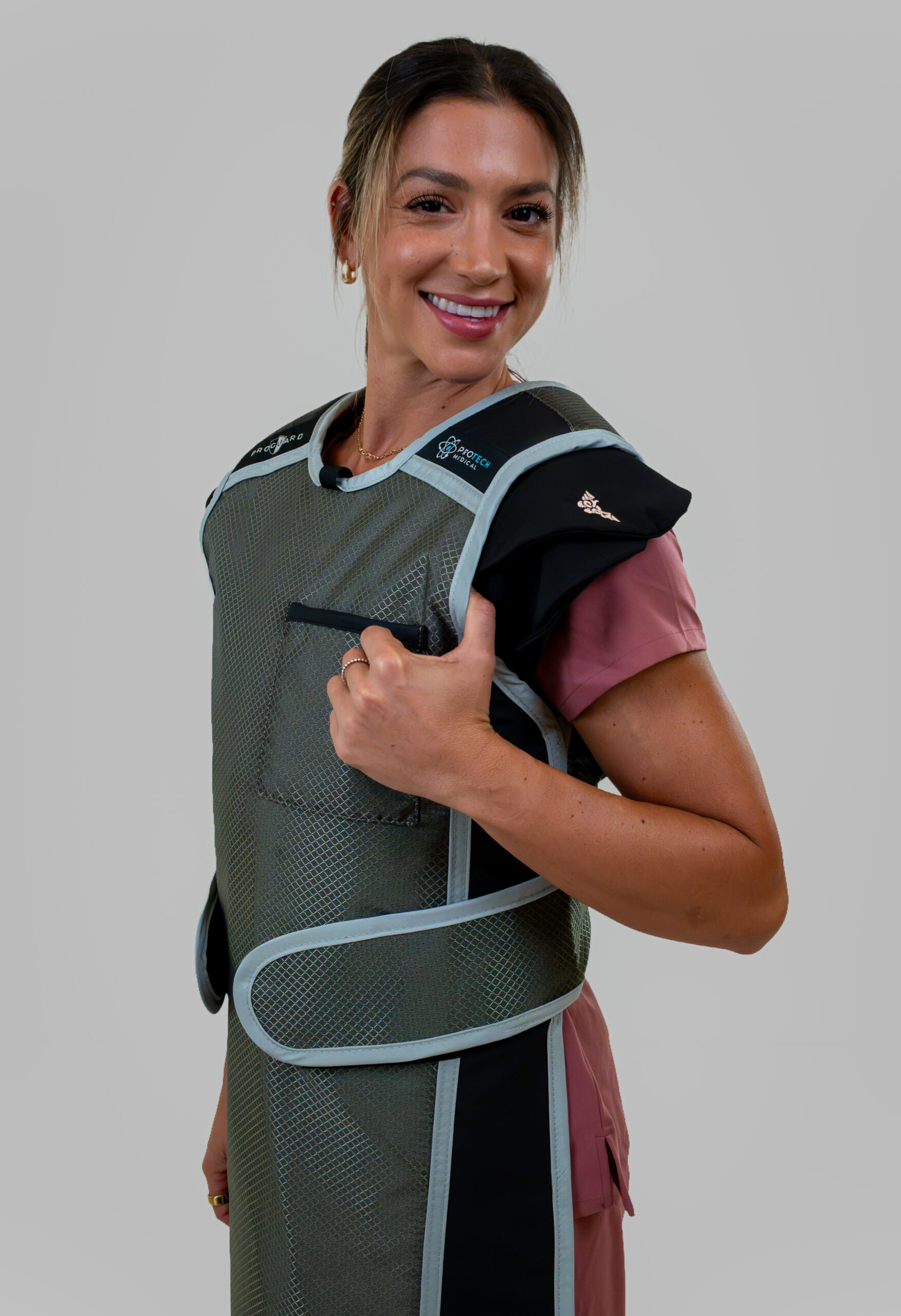
The breast and axillary region is worth singling out for a practical reason. An apron is built to cover the torso, and the armhole has to stay open enough to let you work. Depending on the apron style, the fit and the angle of the C-arm, the underarm and the upper outer chest can be less fully covered in some working positions.. That is coverage geometry, not a flaw in the apron, and it is the reason targeted side and underarm protection has a place in the kit.
What the evidence does and does not say
It is important to be careful here, because this is where fear-marketing tends to creep in. The honest summary is that the published work on interventional staff describes association, not causation.
The often-cited work by Roguin and colleagues, published in 2013, reported that brain and neck tumors among interventional operators were predominantly left-sided, the side that typically sits closer to the scatter source during a case. That pattern is a reason to shield well. It is not proof that any garment prevents cancer, and it should not be read that way. It is an association found in a small group of operators, and the mechanism it points to is occupational exposure over time.
So the claim this article makes is narrow and specific. Radiation protection apparel reduces occupational scatter-radiation exposure to the area it covers. It reduces breast cancer risk, but it is not guaranteed to prevent breast cancer. No apron or supplemental garment can make those promises, and any product that does should be treated with suspicion.
Research that looks directly at upper outer chest coverage shows what that reduction can measure. In a study of 61 fluoroscopically guided interventions, researchers reported 96% attenuation at the measured upper outer chest-wall location when a protective sleeve was added to an apron, compared with 62% for the apron alone (Ramanan B, et al. Added sleeve and upper outer chest-wall attenuation during fluoroscopically guided interventions. Journal of Vascular Surgery. 2024;79(4):948-953). That figure describes how much scatter radiation reaches the area, not an effect on cancer outcomes.
The useful goal is the one ALARA describes: lower the dose you receive at work, consistently, across a career.
How women reduce their exposure at work
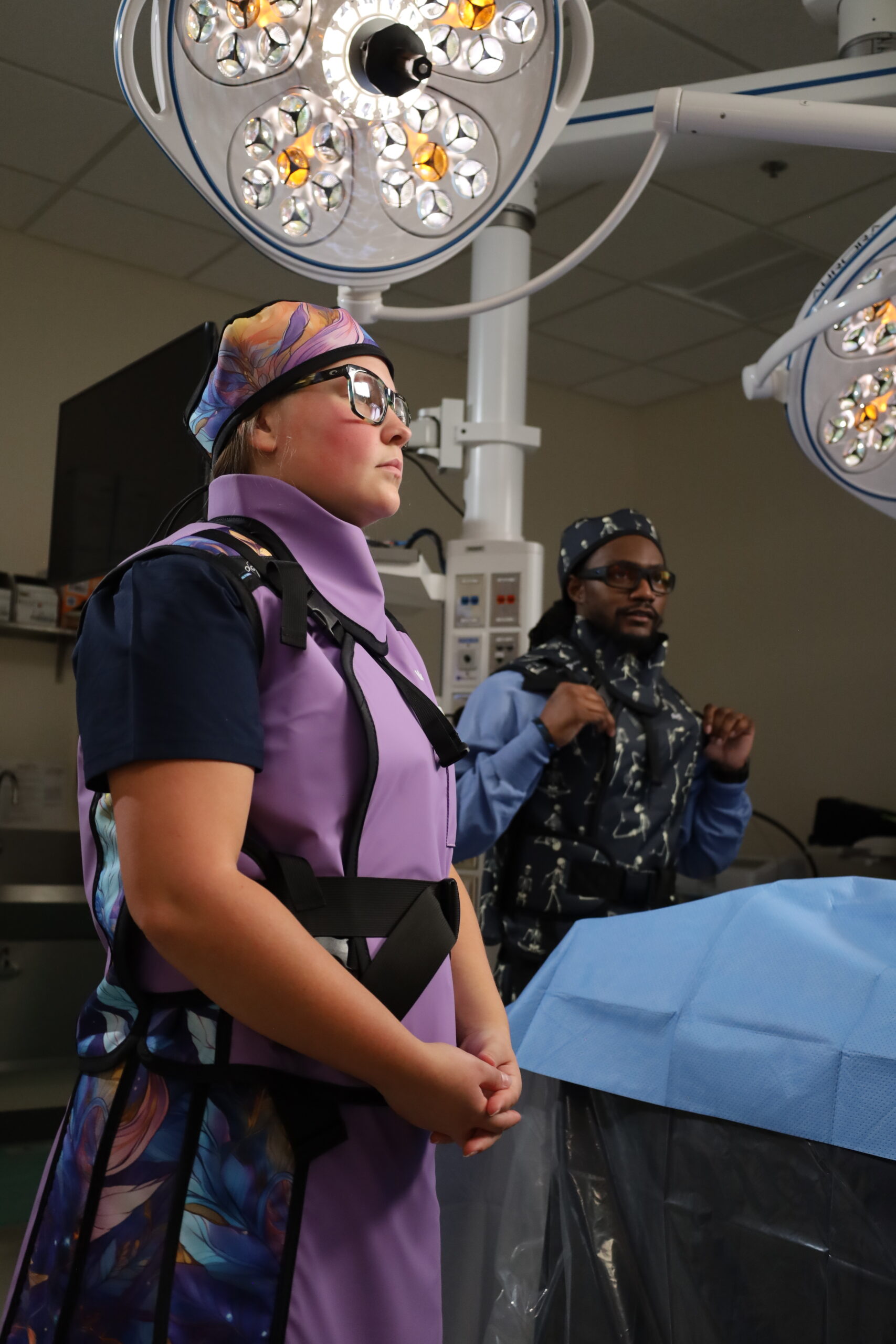
The fundamentals that lower occupational dose are the same for everyone in the room, and they work together rather than in isolation.
Start with a well-fitted apron. A lead or lead-free apron attenuates scatter to the torso, where many radiosensitive organs sit. Fit is not cosmetic. An apron that is too heavy ,sized wrong, or worn incorrectly may have protection gaps at the chest or side. Choosing the right style and core material is part of getting the fit right, especially since a lighter core can make a correctly sized apron easier to wear through a long case. It is worth reviewing lead aprons for medical professionals and comparing core materials with your own caseload in mind. A thyroid collar belongs in the same conversation, and, if that topic is on your radar, our piece honoring Thyroid Cancer Awareness Month is a useful companion read.
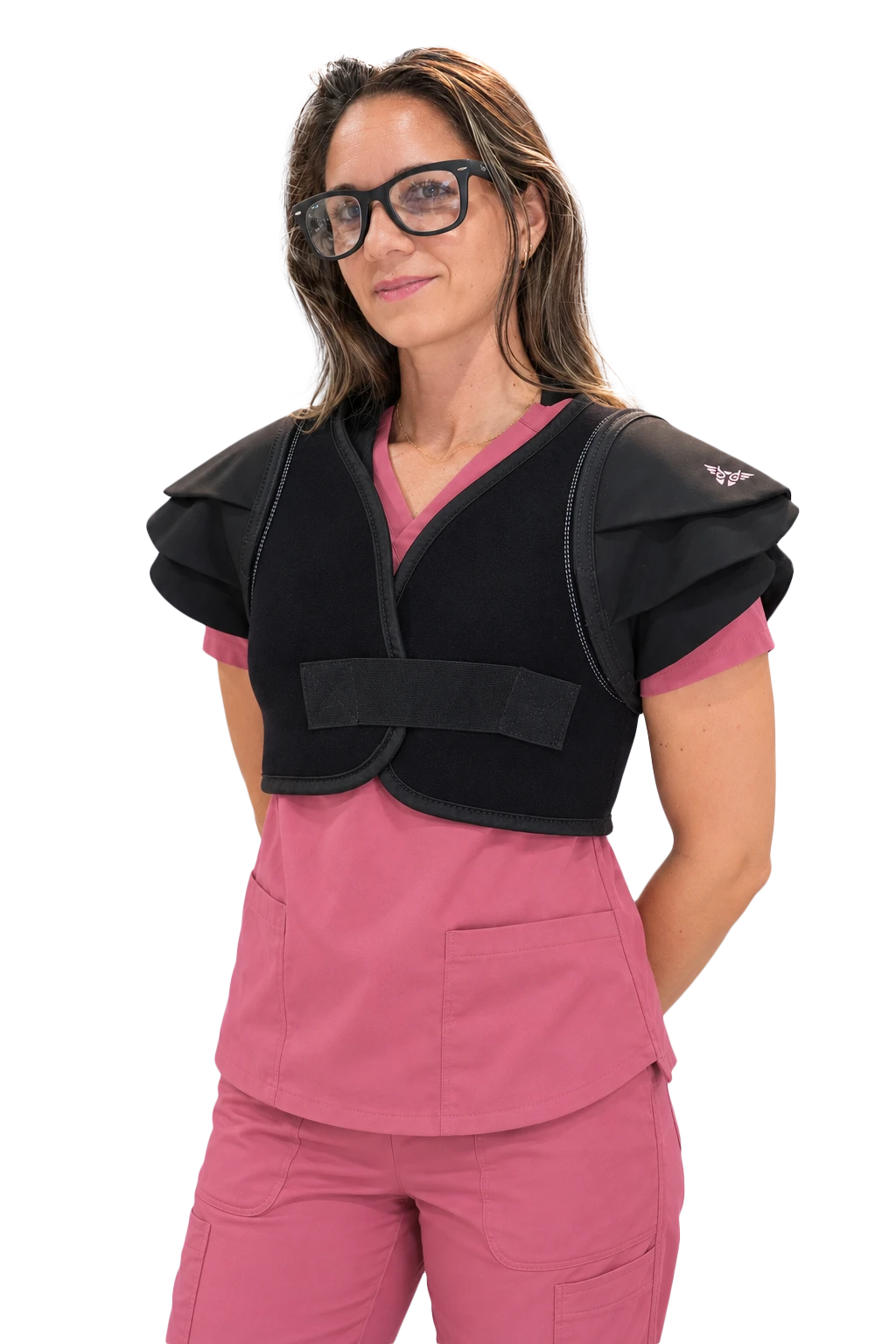
Add targeted axillary protection underneath. This is where supplemental protection earns its place. Protech's Chestmate is supplemental axillary radiation protection worn underneath an existing apron, designed to add coverage at the underarm and upper outer chest without limiting your range of motion. It is compatible with any vendor's apron, and it provides 0.50 mm lead-equivalent protection where the protective panels overlap. Think of it as one more layer over an area an apron does not always cover well, not as a replacement for the apron. You can see how it works on the axillary radiation protection hub and on the dedicated page for the Chestmate .
Use distance and shielding every case. Scatter intensity drops steeply as you step back from the patient, so a step away during an acquisition, when your role allows it, lowers your dose more than most people expect. Table-mounted drapes, scatter drapes, rolling shields and ceiling-suspended barriers block scatter before it reaches you. None of these layers is complete on its own. Worn and positioned together, they are the substance of ALARA rather than just the name of it.
Protech at Making Strides Against Breast Cancer
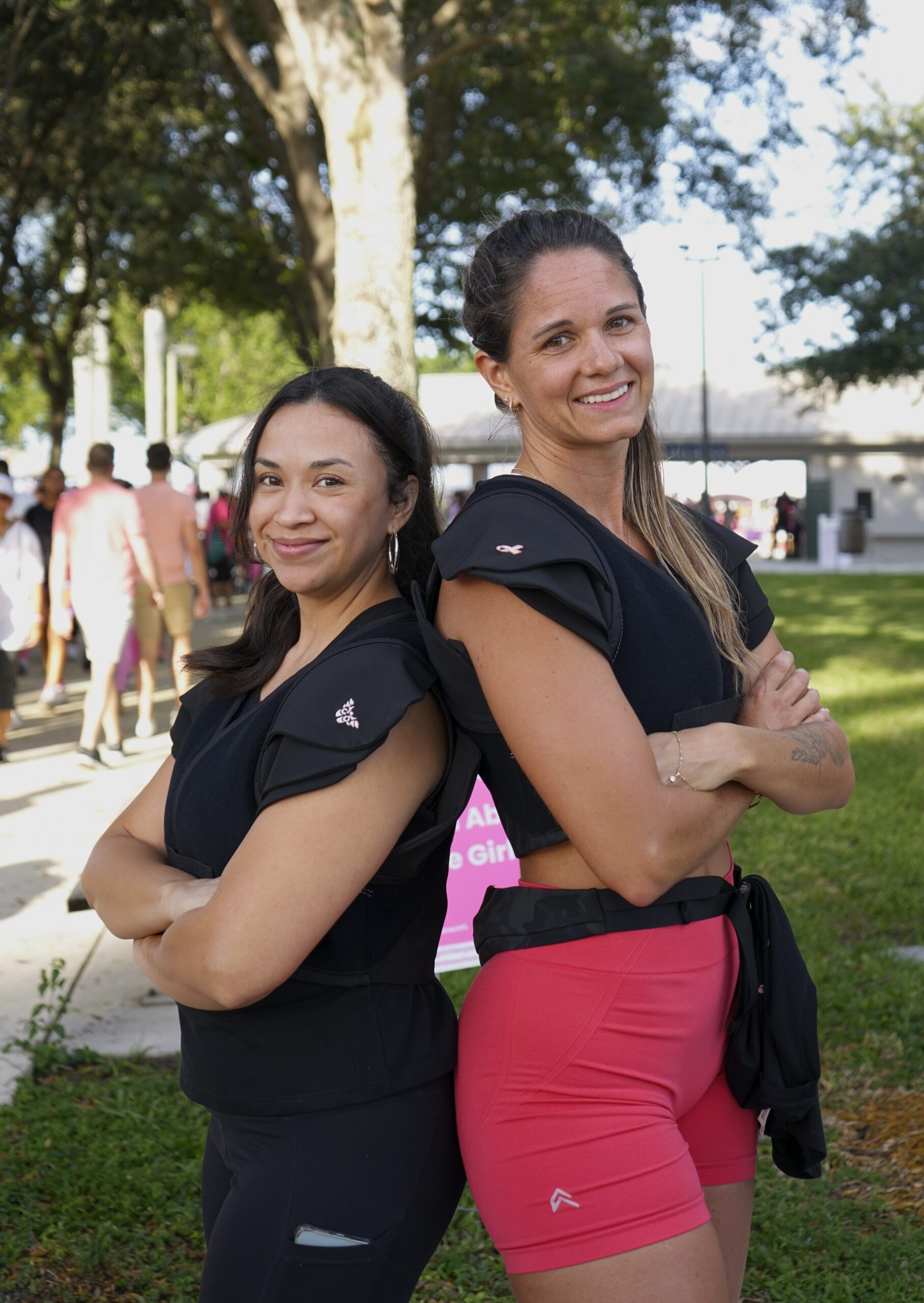
Breast Cancer Awareness Month is also about showing up, so our team is doing exactly that. Protech joined Making Strides Against Breast Cancer on Oct 24, 2026 walking as a team called The Protech'tors, several of them wearing Chestmates. Making Strides Against Breast Cancer is an American Cancer Society event, and you can learn more about the campaign through the American Cancer Society.
Taking part in a community walk is a way to support the cause and the people it affects. It is not a clinical endorsement of any product, and it does not change what the science says. We are walking because this month matters to our team and to the clinicians we build for.

Scatter radiation and Breast Cancer Awareness Month FAQs
What is scatter radiation?
Scatter radiation is the redirected radiation that comes off the patient when the primary X-ray beam strikes them during fluoroscopy or imaging. It travels in every direction, including toward the staff beside the table, which is why everyone in the room should utilize some form of protection. Occupational dose context is attributed to the NRC and NCRP.
Does radiation protection prevent breast cancer?
Radiation protection apparel reduces occupational scatter-radiation exposure to the area it covers. It reduces cancer risk but does not guarantee prevention of breast cancer. The research on interventional staff, including the 2013 Roguin finding of a left-sided tumor pattern, describes an association rather than causation, so it should not be read as proof that any garment prevents disease.
How can women reduce radiation exposure at work?
The same things that work for every team: a properly fitted lead or lead-free apron, targeted axillary protection such as the Chestmate, distance from the scatter source and shielding like table drapes and rolling barriers. Fit and consistent use matter as much as the equipment itself. Your Radiation Safety Officer can tailor this to your caseload.
What is Making Strides Against Breast Cancer?
Making Strides Against Breast Cancer is an American Cancer Society event held in communities across the country. Protech participated on Oct 24, 2026 with a team called The Protech'tors.
Let's talk Protech-tion |
Or call 561.627.9769 to get started.
Explore targeted protection, built in the USA
Lowering your occupational exposure is a system, not a single purchase: a well-fitted apron, supplementary coverage where an apron falls short, distance and shielding, worn during every procedure . When you are ready to add that coverage, explore the Chestmate for supplemental axillary protection, or learn more about axillary radiation protection and how it fits with the apron you already wear. Protech is a family-owned US manufacturer building radiation-protection apparel here in the States since 1994. To talk through sizing, fit or a quote, contact Protech.