ALARA Stands For
Full Meaning, the 3 Cardinal Principles & Real-World Application
Key Takeaways
- ALARA stands for "As Low As Reasonably Achievable," an operating principle that requires minimizing radiation dose proportionate to benefit, technology, and context.
- ALARA is a process, not a dose limit. Meeting regulatory limits is the floor; ALARA is the standard of care.
- The three cardinal principles, time, distance, and shielding, translate ALARA into daily practice.
- Time reductions are linear; distance reductions follow the inverse square law and scale much faster. Shielding attenuates residual exposure.
- Used together, the three principles produce dose reductions that no single principle can achieve alone.
- Clinical application looks different in interventional suites, diagnostic radiography, CT, and pediatric imaging, but the underlying logic is consistent.
- Investigation levels (typically Level 1 at 10% and Level 2 at 25–30% of the annual dose limit, calculated quarterly) are internal benchmarks that catch dose trends early, not regulatory violations.
- ALARA is a shared responsibility across radiologists, technologists, medical physicists, radiation safety officers, therapy teams, nuclear medicine staff, and students.
ALARA stands for “As Low As Reasonably Achievable.” Each word of the sentence is important, and explaining each one clarifies what the principle actually requires of clinicians and safety officers.
- “As Low As” the direction of the effort is always toward reducing dose, never merely maintaining it under a legal ceiling.
- “Reasonably” the principle does not demand minimization at any cost. It demands minimization that is proportionate to the benefit, the available technology, and the economic and social context.
- “Achievable” the standard is what can actually be accomplished in practice, not a theoretical ideal.
The U.S. Code of Federal Regulations (10 CFR 20.1003) formalizes this by defining ALARA as making every reasonable effort to maintain exposure to ionizing radiation as far below the applicable dose limits as is practical, considering the state of technology, the economics of improvement relative to benefits to public health and safety, and other societal and socioeconomic factors.
ALARA is not a dose limit. It’s a continuous, evaluative process. A facility that meets every regulatory limit can still fall short of ALARA if it fails to implement improvements that are within reach.
Conversely, a facility that exceeds ALARA expectations through disciplined practice can drive measured occupational doses to a small fraction of regulatory ceilings.
Why ALARA Matters in Clinical Practices
The reason ALARA is worded the way it is, and enforced the way it is, comes down to three practical realities that every radiologic professional operates under.
Radiation dose accumulates. A technologist, interventional cardiologist, or medical physicist is not exposed once per year. They are exposed across thousands of procedures over a career. Small per-case reductions compound into meaningful lifetime risk reduction.
A procedure that saves 20 percent of fluoroscopy time sounds incremental, but multiplied across 5,000 procedures over a 20-year career, the difference is substantial.
There is no confirmed safe threshold. Modern radiation protection is built on the linear-no-threshold (LNT) model, which assumes the probability of stochastic effects such as cancer increases linearly with dose and has no lower cutoff.
Under that model, every increment of dose matters. ALARA is the operational response to that uncertainty: minimize what can be minimized, regardless of whether the current dose is “small.”
Compliance and audit consequences are real. In the United States, ALARA is a legally enforceable expectation for NRC-licensed facilities under 10 CFR 20.1101. Programs must be documented, reviewed annually, and include investigation levels that trigger internal review before regulatory limits are reached.
State regulators and accreditation bodies expect to see those records in an audit.
Meeting the dose limit is the floor. ALARA is the standard for care.
The 3 Cardinal Principles of ALARA: Time, Distance, and Shielding
The three cardinal principles translate the ALARA philosophy into practice. Any clinician working near ionizing radiation is always using some combination of them, whether consciously or not. Using them deliberately is what separates a radiation-conscious practice from one that is only compliant.
1. Time
The total dose a worker receives is a direct function of how long they are exposed. Reducing exposure time by half reduces the accumulated dose by roughly half. The relationship is linear and unambiguous.
How it works in practice:
- Pulsed fluoroscopy over a continuous beam. Modern fluoroscopes allow the operator to select pulsed imaging at reduced frame rates (7.5 or 15 pulses per second rather than 30 continuously). For many interventional tasks, lower pulse rates deliver adequate visualization at a fraction of the dose.
- “Last image hold” and “store fluoro” functions. These features let the operators freeze and review the most recent image without continuing to expose. Reviewing a held image instead of re-fluoroscoping is one of the highest-yield time-reduction techniques available.
- Beam-off discipline. The foot pedal should be pressed only when the operator is actively looking at the monitor. This sounds trivial in practice; it is one of the most commonly violated rules at the procedure table.
- Efficient workflow planning. Non-radiation steps, such as catheter preparation, team communication, and needle positioning, should all happen outside of beam-on time. Procedures practiced mentally or with the team before activation of the source cut live radiation time drastically.
- Staff rotation. For high-volume departments, rotating staff through cases that involve radiation exposure prevents any single individual from accumulating excessive daily or weekly doses.
Time discipline is free. It requires no capital investment, no new equipment, and no regulatory approval, only the habits of the team using the fluoroscope.
2. Distance
Radiation dose from a point source decreases sharply with distance. For X-rays and gamma rays, the relationship follows the inverse square law, where the dose is inversely proportional to the square of the distance from the source.
This means that doubling the distance from a radiation source reduces exposure to roughly one-quarter. Tripling the distance reduces it to roughly one-ninth. Even modest increases in distance produce disproportionately large reductions in dose.
One widely known shorthand is the “6-foot rule,” which is the idea that stepping back six feet reduces exposure to near zero. The intent is sound, but the framing is not. At six feet, dose is in fact meaningfully reduced, but it’s not negligible, especially in high scatter interventional environments where cumulative exposure over a career is the primary concern.
The inverse square law does not produce a safe distance. It produces a continuum, where every additional foot of separation compounds the benefit.
How it works in practice:
- Step back during image acquisition. In interventional suites, staff who do not need to be within arm’s reach of the patient during a cine run should take one or two steps back. The dose reduction is immediate and substantial.
- Use the longest practical working distance. For C-arm and portable imaging, positioning the operator at the maximum distance compatible with the task is a design decision, not a safety afterthought.
- Lengthen exposure cords and remote controls. For portable radiography and certain fluoroscopic tasks, extended exposure cords and remote switches let the operator stand two meters or more from the source.
- Position the image intensifier close to the patient. Raising the intensifier moves it away from the patient, which both degrades image quality and increases operator scatter exposure. Keeping the intensifier as close to the patient as clinically feasible is both a dose-reduction technique and an image-quality technique.
- Understand source geometry: Scatter is not uniform. It is most intense on the side of the patient closest to the X-ray tube. Staff positioning on the image-intensifier side rather than the tube side can meaningfully lower the dose without compromising access.
Distance is the single most powerful of the three principles. Small changes in position produce outsized changes in dose.
3. Shielding
Placing an attenuating material between the source and the worker absorbs radiation before it reaches the body. For X-rays and gamma rays in medical settings, lead is the dominant shielding material because of its high atomic number and density.
Shielding operates at three levels:
- Structural shielding: Lead-lined walls, doors, and observation windows built into imaging suites. This is the permanent, facility-level shielding that supports everything else.
- Equipment-mounted shielding: Ceiling-suspended shields, table-mounted drapes, and mobile leaded acrylic barriers. These shields sit between the patient (the scatter source during most clinical exposures) and the operator. When positioned correctly, ceiling-suspended shields can reduce operator head and neck dose by an order of magnitude in interventional settings.
Personal Protective Equipment (PPE)
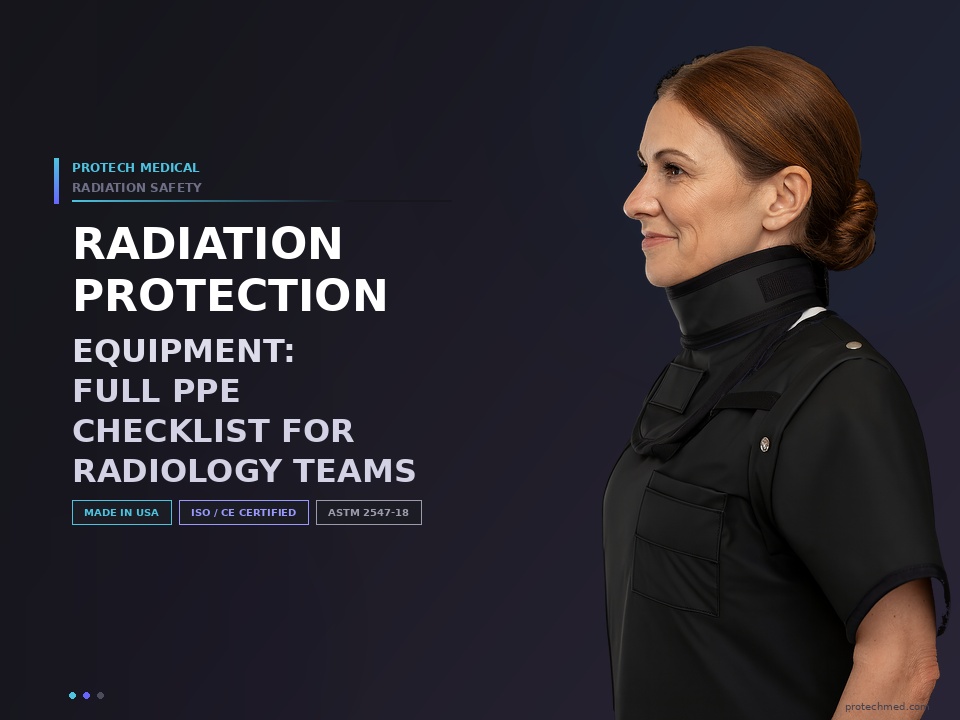
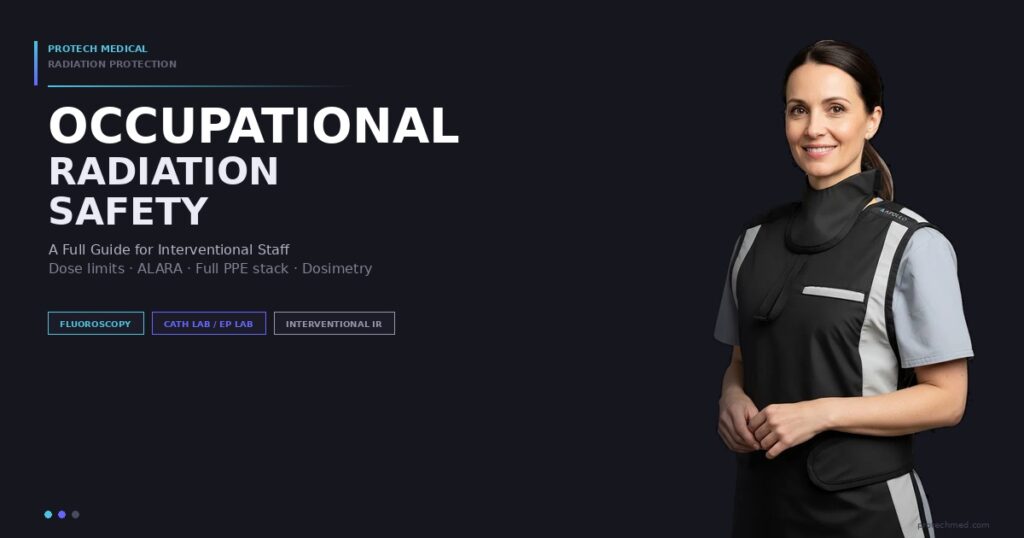
- Lead Apron: This is the foundational PPE for any worker within scatter range of a fluoroscopy or interventional source, with lead equivalencies typically ranging from 0.25 to 0.5 mm Pb depending on the procedure and role.
- Thyroid Shields: They are essential for protecting the highly radiosensitive thyroid gland, with Pb equivalent.
- Leaded Eyewear: Protects the lens of the eye against radiation-induced cataracts, with 0.75 mm Pb equivalent or higher providing substantial attenuation.
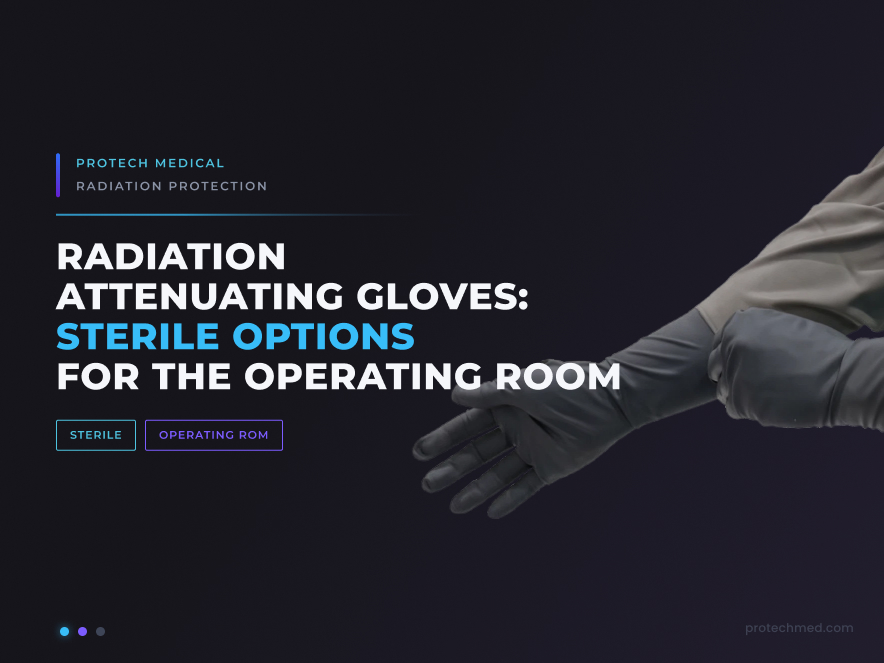
- Lead Gloves: Used when the hands must remain near or within the primary or scatter field, such as during specific interventional procedures.
- Mobile Barriers: These are wheeled, leaded acrylic shields that supplement personal PPE and structural shielding in flexible configurations.
How the Three Principles Work Together
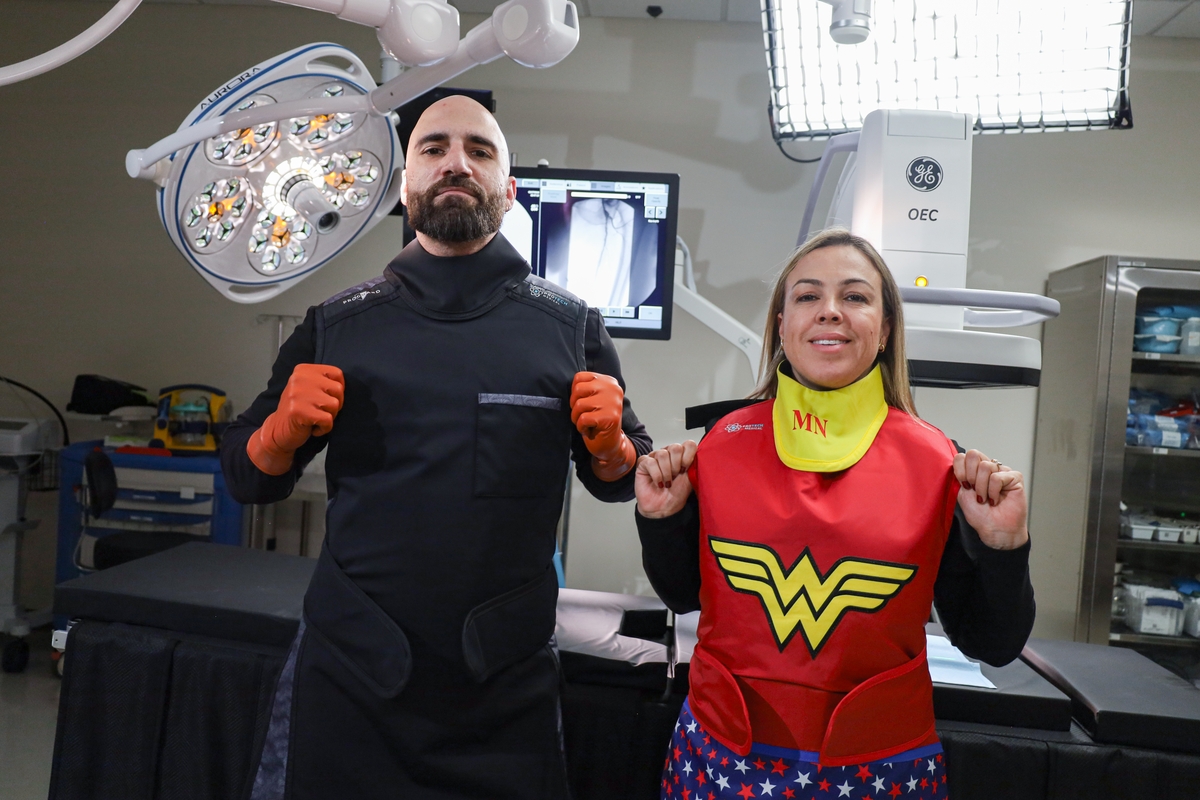
Time, distance, and shielding are multiplicative, not mutually exclusive. An interventional cardiologist performing a complex case is simultaneously minimizing beam-on time with pulsed fluoroscopy, maintaining the longest practical distance from the table, working behind a ceiling-suspended shield, and wearing a lead apron and thyroid shield.
Effective radiation protection is also a shared responsibility. Individual practitioners are accountable for their own protective habits, such as wearing assigned PPE consistently, maintaining appropriate distance, and understanding the dose implications if they fail to meet safety guidelines.
Facilities are equally responsible for ensuring that properly specified, well-maintained equipment is available to every staff member who needs it.
Each principle reduces dose; together they do so by factors that single-principle approaches cannot match, and ALARA lives at the intersection.
Real-World Applications
Translating the three principles into daily workflow is where ALARA programs either succeed or fail.
Interventional Fluoroscopy and Cath Lab
Interventional cardiology, vascular surgery, and interventional radiology all present the highest occupational doses in medicine because operators stand within scatter range for extended periods. ALARA implementation in these settings includes:
- Pulsed fluoroscopy at the lowest frame rate compatible with the task.
- Ceiling suspended and table-side shields are positioned before the case begins, not after.
- Wrap-around lead aprons or skirt-and-vest configurations that cover 360 degrees, since operators frequently turn relative to the source.
- Dose tracking in real time through the C-arm’s air kerma and dose-area product displays.
Diagnostic Radiography and Portable Imaging
For general radiography, ALARA manifests as correct technique selection, tight collimation, and operator positioning. For portable units in the ICU or at bedside, the exposure cord should allow the technologist to stand at least two meters from the tube at an angle to the beam.
This allows for a combination of distance and shielding (the patient and equipment themselves attenuate some scatter).
CT and Dose Optimization
CT delivers the largest share of medical radiation exposure in most facilities. ALARA in CT rests on protocol optimization. Tube current modulation, interactive reconstruction, and appropriate kVp selection.
Repeat scans are a common dose-accumulation failure; every repeat is a new exposure.
Who Applies ALARA and How
ALARA is not only the concern of radiation safety officers. It’s a shared responsibility across every role that encounters ionizing radiation.
- Radiologists and radiologic technologists apply ALARA every time they select a technique, collimate a field, or reposition the patient during a portable exposure.
- Interventional physicians apply ALARA principles through pulse rate selection, shield positioning, and beam-off discipline.
- Medical physicists apply ALARA through protocol optimization, equipment quality assurance, and dose monitoring program design.
- Radiation safety officers: apply it through treatment planning optimization, patient-specific shielding, and staff-area monitoring.
- Nuclear medicine staff apply ALARA through radiopharmaceutical handling protocols, waste management, and patient education on post-procedure precautions.
Every person in the room shares responsibility for ALARA, and every person in the room has tools, such as time, distance, and shielding, to act on it.
Putting ALARA Principles Into Practice
Time and distance are free. Shielding isn’t, and the quality of that shielding determines how much protection the other two principles can actually deliver.
Protech Medical builds radiation protection equipment to close those gaps: lead aprons, thyroid shields, leaded eyewear, and mobile barriers engineered to verified attenuation specifications, with ergonomic designs that support sustained wear and documentation that stands up to annual inspection and audits.
Ready to equip your team with radiation protection that supports real-world ALARA application? Explore our full range of protective equipment or contact our team to discuss your facility’s requirements.
Frequently Asked Questions About ALARA
What does ALARA stand for? ALARA stands for "As Low As Reasonably Achievable." Each word is deliberate: the goal is always to reduce dose (as low as), in a way that is proportionate to available technology and resources (reasonably), and within what can actually be done in practice (achievable).
What are the 3 cardinal principles of ALARA? Time, distance, and shielding. Minimize the time spent near the source, maximize the distance from it, and place appropriate attenuating material between the worker and the source. The three principles are multiplicative. Using them together produces a far greater dose reduction than any one alone.
How does the inverse square law apply to ALARA? For point sources of X-rays and gamma rays, the dose rate decreases with the square of the distance. Doubling the distance reduces the dose to roughly one-quarter; tripling the distance reduces it to roughly one-ninth. This makes distance the most mathematically powerful of the three cardinal principles.
What is the difference between ALARA Level 1 and Level 2? Both are internal investigation thresholds, not regulatory violations. Level 1 is typically set at 10% of the annual dose limit (calculated quarterly) and triggers notification and a practice review. Level 2 is typically 25–30% of the annual dose limit and triggers formal investigation, root-cause analysis, and a corrective action plan, generally overseen by the Radiation Safety Officer.
How does ALARA apply to patients as well as staff? ALARA applies to any exposure to ionizing radiation that does not provide a direct benefit proportionate to the dose. For patients, this means justifying every exposure, optimizing protocols for the specific clinical question, and using the lowest diagnostic-quality technique. In pediatrics in particular, ALARA is often extended through ALADA and ALADAIP, which emphasize that dose reduction cannot compromise diagnostic value.
Who is responsible for ALARA at a medical facility? Everyone who works near ionizing radiation shares responsibility for ALARA, but the formal program is owned by the Radiation Safety Officer (RSO), supported by medical physicists, department leadership, and the Radiation Safety Committee. Documentation, training, and investigation-level enforcement are the RSO's core duties.